
Heat Index Calculator
During hot summer days it sometimes feels hotter outside than the actual temperature suggests and it might very well be when you consider the “Heat Index”.
The heat index is a mathematical combination of air temperature and relative humidity which provides you the “how hot it really feels” temperature. Let me explain, when our bodies sweat the water evaporates carrying heat away from the skin allowing us to cool down, however when the humidity is high water does not evaporate as fast so the body retains more heat and you feel hotter. Below is a heat index conversion calculator so you can know the “how hot it really feels” temperature…..
Looking for a deeper understanding? Below is the heat index equation….
HI = -42.379 + 2.04901523T + 10.14333127R – 0.22475541TR – 6.83783×10⁻³T2 – 5.481717×10⁻²R2 + 1.22874×10⁻³T2R + 8.5282×10⁻⁴TR2 – 1.99×10⁻⁶T2R2
HI = Heat Index
T = ambient dry bulb temperature (°F)
R = relative humidity (integer percentage)
For more read the “The Heat Index Equation” paper written by National Weather Service Meteorologist Lans P. Rothfusz.
This entry was posted in Weather Articles and tagged conversion calculator, dry bulb temperature, heat, heat index, relative humidity, weather calculator, weather tools. Bookmark the permalink.
Read More

NOAA Forecasts Below-Normal 2026 Atlantic Hurricane Season: Why You Should Still Prepare
The 2026 Atlantic hurricane season forecast is below-normal, but that's not a reason to relax. NOAA released its 2026 Atlantic hurricane season forecast on May 21, giving the season a 55% chance of being below normal,…
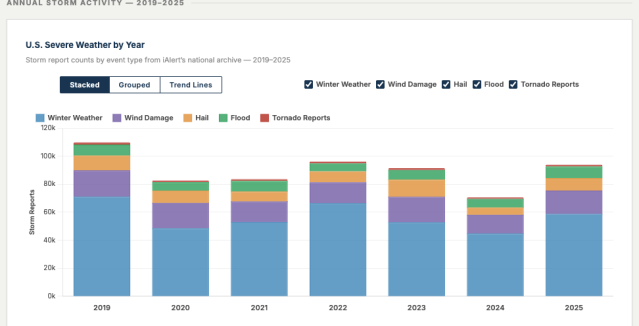
2025 U.S. Severe Weather Report — Storm, Tornado, and NWS Alert Statistics
Each year, iAlert publishes an annual severe weather report covering storm activity across the United States. The reports draw from iAlert's national storm report database, including spotter reports, sensor data, and official severe weather records from…

2026-2031 Atlantic Hurricane Names
The Atlantic hurricane season runs June 1 through November 30 each year. Storms are named alphabetically from a predetermined list beginning with "A" through "W", excluding names beginning with "Q" or "U." A storm receives its…