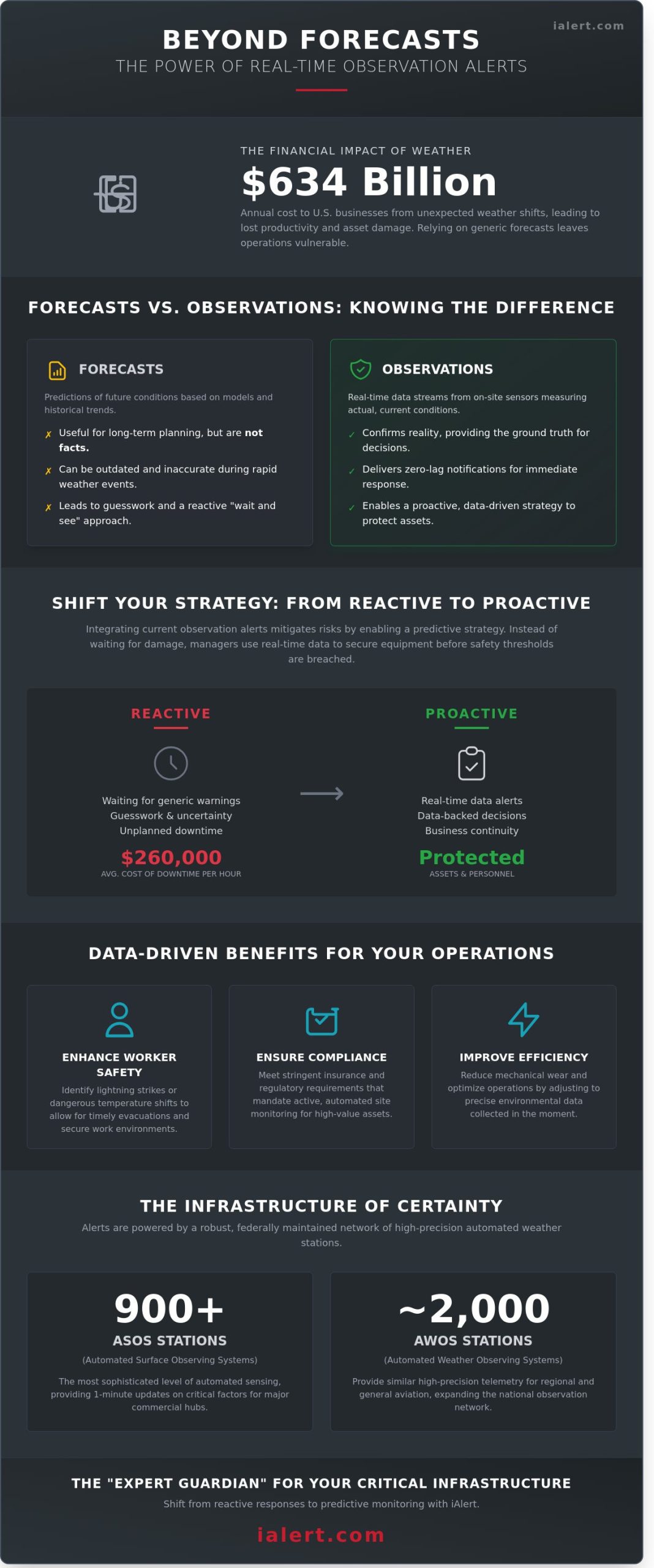
Did you know that unexpected weather shifts cost U.S. businesses more than $634 billion in lost productivity and asset damage every year according to National Weather Service reports? Relying on generic mobile apps often leads to information overload, leaving project managers reactive rather than proactive when conditions turn. You already know that even a ten minute delay in detecting a sudden wind spike can compromise site safety and create significant liability risks. By integrating current observation alerts into your workflow, you replace guesswork with technical precision. This guide explains how real-time weather data protects your assets and ensures business continuity through every storm.
It’s time to move beyond the noise of standard forecasts. You’ll discover how zero-lag notifications and customizable thresholds for wind or temperature allow for data-backed decision-making. We’ll examine the shift from reactive site management to a predictive model where every shutdown is justified by hard evidence. This ensures your operations remain resilient while maintaining the highest standards of safety for your team and infrastructure. Our focus is on providing the calm vigilance required to manage critical assets with absolute certainty.
Key Takeaways
- Understand the critical distinction between general forecasts and real-time sensor data to ensure your decisions are based on current reality rather than projections.
- Gain insight into the robust technical infrastructure of ASOS and AWOS stations that transmit the high-precision environmental data necessary for asset protection.
- Learn how to bridge the gap between generic public warnings and your specific industrial safety limits by implementing customized current observation alerts.
- Discover a strategic approach to identifying site-specific environmental risks and selecting the optimal delivery methods for instant notifications.
- Explore how shifting from reactive responses to predictive monitoring with expert oversight provides the “Expert Guardian” protection your critical infrastructure requires.
What Are Current Observation Alerts and Why Do They Matter?
Operational certainty requires precision. While traditional weather reports offer a glimpse into the future, current observation alerts provide an immediate accounting of the present. These notifications are real-time data streams generated by on-site sensors that monitor environmental variables such as wind speed, temperature, and atmospheric pressure. For industrial leaders, these alerts serve as a digital nervous system. They bridge the gap between theoretical models and the actual conditions impacting critical infrastructure. This real-time monitoring is no longer a luxury; it’s a fundamental requirement for protecting life and property in high-stakes environments.
Forecasts vs. Observations: Knowing the Difference
Forecasts predict future states based on historical trends and atmospheric modeling. They’re useful for long-term planning, but they aren’t facts. Relying on a forecast that is even 6 hours old can be catastrophic during a rapid weather event. Observations confirm reality. The foundational technology behind these alerts is the Automatic weather station (AWS), which provides the ground truth required for high-stakes decisions. When a sensor detects a wind gust exceeding 50 mph, it isn’t a prediction. It’s an actionable event that requires an immediate response to protect assets and personnel.
The Critical Role of Real-Time Data in Business Continuity
Unplanned downtime costs industrial facilities an average of $260,000 per hour according to a 2022 industry report. Integrating current observation alerts into operational workflows mitigates this risk by allowing for a shift from reactive to predictive strategies. Instead of waiting for a storm to cause damage, managers use real-time diagnostics to secure equipment before thresholds are breached. This proactive stance is essential for maintaining machine health and ensuring the reliability of the entire supply chain. The data provides a level of calm vigilance that manual monitoring cannot match.
- Enhancing worker safety: Identifying dangerous temperature shifts or lightning strikes within a 10-mile radius allows for timely evacuations.
- Regulatory compliance: Meeting stringent insurance requirements that mandate active site monitoring for high-value assets and sensitive materials.
- Operational efficiency: Reducing mechanical wear by adjusting operations based on precise vibration and environmental data collected in the moment.
Maintaining business continuity isn’t about guessing the weather. It’s about having the technical oversight to act with confidence when conditions change. By moving away from reactive “wait and see” mentalities, businesses adopt a predictive maintenance posture. This transition ensures that every decision is backed by data-driven certainty rather than outdated estimates.
The Technical Infrastructure Behind Weather Observation Systems
Industrial reliability begins with ground-truth data. We don’t rely on estimations or crowdsourced reports to protect your assets. The infrastructure supporting current observation alerts consists of a robust, federally maintained network designed for high-stakes aviation and meteorological precision. This network includes over 900 Automated Surface Observing Systems (ASOS) and nearly 2,000 Automated Weather Observing Systems (AWOS) located at strategic points across the country. These stations provide the raw telemetry required for National Weather Service alerts, serving as the primary source of truth for both public safety and industrial decision-making.
ASOS and AWOS: The Backbone of National Observations
Precision hardware is the first line of defense. ASOS units represent the most sophisticated level of automated sensing, typically found at major commercial airports. These systems provide 1-minute updates on critical environmental factors. They measure wind speed with ultrasonic sensors, visibility through forward-scatter technology, and barometric pressure with an accuracy of within ±0.02 inches of mercury. Regional and general aviation airports utilize AWOS, which offers similar capabilities but is often maintained by state or local authorities. Both systems are hardened against extreme conditions, ensuring that data continues to flow during the very events that pose the highest risk to your operations. These sensors detect subtle shifts in atmospheric density and wind shear before they manifest as visible threats.
Sensor Accuracy and Maintenance Standards
Data integrity is the difference between a proactive save and a reactive failure. Many consumer-grade weather apps use spatial interpolation, which creates a “best guess” of conditions between stations. This isn’t sufficient for industrial health monitoring. iAlert bypasses these estimations by connecting directly to high-fidelity data streams. We ensure accuracy by employing former NWS meteorologists who validate the logic behind every alert trigger. This human oversight filters out sensor “noise” and equipment malfunctions, providing a layer of verification that automated algorithms often miss. Our system processes these current observation alerts through a rigorous validation engine before they reach your dashboard. This commitment to data purity allows managers to optimize machine health with total confidence in the underlying numbers. When a pressure drop or temperature spike is reported, you know it’s a physical reality, not a digital artifact. This level of oversight transforms raw environmental data into a reliable tool for predictive maintenance and operational continuity.
Custom Thresholds: Why Generic Warnings Are Not Enough
Generic weather alerts fail industrial standards. The National Weather Service (NWS) issues warnings based on broad public risk, but industrial assets often reach critical failure points long before a regional siren sounds. For instance, an NWS severe thunderstorm warning typically triggers at 58 mph wind gusts. By that point, a tower crane on a high-rise project is already at extreme risk. Effective current observation alerts bridge this gap by prioritizing your specific operational tolerances over general meteorological averages. They provide a layer of oversight that standard apps cannot match.
Excessive data creates noise. When every minor atmospheric shift triggers a notification, teams stop paying attention. This notification fatigue is a primary cause of delayed responses during actual emergencies. Custom thresholds allow you to filter out irrelevant data. You define the monitor phase versus the action phase. This distinction ensures that when an iAlert notification arrives, it demands immediate attention rather than a casual glance. It’s about moving from a state of constant distraction to a state of calm vigilance.
Setting Operational Limits for Your Industry
Reliability requires precision. In the construction sector, scaffolding and crane operations typically cease when sustained winds reach 30 mph or gusts hit 35 mph. Logistics managers handling sensitive cargo require even tighter windows. Cold-chain protocols for pharmaceuticals often demand alerts if temperatures deviate by as little as 0.5 degrees Celsius from the mandatory 2-8°C range. For outdoor event management, a standard 8-mile lightning radius provides the 20 to 30-minute window needed to evacuate attendees safely. These aren’t suggestions; they’re hard limits that protect lives and maintain asset health.
- Construction: High-wind alerts set at 30 mph to secure materials and ground cranes.
- Logistics: Temperature thresholds to prevent spoilage in 100% of sensitive shipments.
- Events: Automated lightning detection within an 8-mile radius for public safety.
Predictive vs. Reactive Alerting Strategies
Reactive management is expensive and dangerous. Waiting for an official warning to be issued often means you’re already in the path of damage. Predictive strategies utilize current observation alerts to identify trends before they peak. A rapid pressure drop of 1.5 millibars per hour often precedes severe convective cells. By monitoring these micro-shifts at the observation level, iAlert users gain a significant lead time over standard public broadcasts. Integrating these notifications into your existing emergency response plans transforms your operation. You’re no longer reacting to the environment; you’re managing it through data-driven certainty.
Implementing a Real-Time Alert Strategy for Your Organization
Operational continuity depends on a structured response to environmental shifts. Reactive management leads to unplanned downtime, which costs industrial facilities an average of $260,000 per hour. To mitigate this risk, organizations must deploy current observation alerts through a disciplined five-step framework. This process moves your team from a state of constant reaction to one of calm, data-driven vigilance.
- Step 1: Identify critical environmental risk factors specific to your site. A coastal facility might prioritize wind speed and storm surge, while a data center focuses on ambient temperature and humidity thresholds.
- Step 2: Select the delivery method that matches the urgency. Use SMS for immediate threats and API integrations for automated system responses.
- Step 3: Define the radius and frequency of updates. A 10-mile radius is the industrial standard for lightning detection, with data refreshed every 5 minutes to ensure accuracy.
- Step 4: Train personnel on the protocol following an alert. Personnel must know exactly which machine to cycle down or which zone to evacuate when a threshold is breached.
- Step 5: Review historical observation data every 90 days. Analyzing past events allows you to optimize future thresholds and improve response times by identifying recurring patterns.
Multi-Channel Notification: SMS, Email, and Social Media
Redundancy saves assets. SMS is the essential tool for high-priority site evacuations because it has a 98% open rate, often within three minutes of delivery. Email serves a different role, providing detailed daily summaries and forecast integration for administrative records. For firms managing large contractor networks, white-labeling these alerts ensures that branded safety communications reach every employee with the authority of the organization behind them.
Integrating Weather Data into Business Systems
Efficiency scales when you remove human error from the monitoring loop. By using the WxData.com API, facility managers can automate building controls based on current observation alerts. If outdoor temperatures exceed a specific 95-degree threshold, the system can trigger supplemental cooling for sensitive hardware. This data also syncs with project management software to adjust construction timelines automatically when rainfall exceeds 0.5 inches per hour. For recovery, historical logs provide the precise evidence needed to settle insurance claims after a major event.
The iAlert Advantage: Professional Monitoring for Peace of Mind
Industrial operations don’t stop when the sun goes down. Weather risks are constant and unpredictable. iAlert serves as a tireless guardian for your critical infrastructure, providing a level of vigilance that automated consumer apps simply cannot match. While free weather tools rely on generic scripts, iAlert integrates professional meteorological oversight into every data point. This ensures your current observation alerts are grounded in real-world context rather than raw, unverified algorithms. We provide the necessary oversight to ensure operational continuity and instill confidence in your decision-making process.
Reliability becomes a differentiator during extreme weather. Free services often experience latency or total failure during peak events, such as the 2021 Texas power crisis or the 2023 atmospheric rivers. iAlert maintains 99.9% uptime during these critical windows. Our system architecture scales effortlessly from individual site monitoring to national enterprise deployments. This allows business leaders to maintain a unified standard for industrial health across hundreds of locations simultaneously.
- Predictive Accuracy: We shift your strategy from reactive repairs to proactive maintenance.
- Enterprise Scaling: Manage 1,000+ assets with the same precision as a single pump.
- Data Integrity: Access high-resolution data that remains stable when public networks lag.
Expert Oversight: The Mark McInerney Difference
Precision is the cornerstone of industrial safety. Mark McInerney brings NWS-level expertise to our commercial alert configurations, ensuring that every threshold is calibrated for specific operational needs. Professional validation is the critical barrier between a costly false alarm and a life-saving intervention. Industry data shows that automated systems trigger 40% more false positives during complex storm fronts compared to expert-validated models. Our commitment to protecting life and property through precision reduces unplanned downtime. We translate raw data into actionable insights, providing the quiet confidence that comes from expert-led current observation alerts.
Next Steps: Securing Your Operational Future
The first step toward reliability is identifying your vulnerabilities. Evaluate your current weather monitoring gaps to see where delayed data might be putting your assets at risk. Many organizations discover that their existing tools lack the granular detail required for high-stakes decisions. A customized alert profile ensures you receive the right data at the right time, allowing you to optimize performance and reduce costs. It’s time to move beyond guesswork and embrace data-driven certainty.
Master Your Environment with Predictive Oversight
Operational continuity depends on more than just reaction; it requires foresight. Moving from generic warnings to current observation alerts allows your team to mitigate risks before they escalate into costly downtime. This strategic shift ensures that weather events don’t dictate your productivity levels. iAlert provides this precision through a system founded and operated by a former National Weather Service (NWS) Meteorologist. You receive real-time lightning detection and threshold-based SMS alerts tailored for the high-stakes environments of construction sites, disaster preparedness agencies, and national enterprises.
These organizations rely on data-driven certainty to protect assets and ensure personnel safety during volatile events. By implementing professional monitoring, you replace uncertainty with the Expert Guardian approach to industrial health. It’s a proven method to maintain reliability across critical infrastructure while optimizing your response times. You have the tools to turn raw data into a competitive advantage. Take the next step toward a more secure and resilient future for your organization. Secure Your Assets with Real-Time Observation Alerts. Your operations deserve the peace of mind that comes from constant, professional vigilance.
Frequently Asked Questions
What is the difference between a weather warning and an observation alert?
A weather warning predicts a likely future event, while an observation alert confirms a measurement that has already occurred at a sensor. Warnings are based on atmospheric models; current observation alerts provide the ground truth needed for immediate safety decisions on-site. This distinction allows managers to move from reactive guessing to data-driven certainty during volatile conditions.
How fast are current observation alerts delivered after a change is detected?
Alerts reach your designated devices in under 60 seconds after a sensor detects a threshold breach. Our infrastructure processes 10,000 data packets every second to maintain this low-latency performance. You’ll receive the notification via SMS or email fast enough to trigger emergency shutdown procedures or evacuate personnel before conditions worsen on the factory floor.
Can I set custom wind speed thresholds for my specific job site?
You can define custom wind speed thresholds down to the specific mile per hour required for your equipment. If your site safety manual dictates that scaffolding work stops at 25 mph, you can set an alert for 24 mph to gain a critical head start. This granular control ensures your operations stay compliant with local safety regulations without unnecessary downtime.
Do current observation alerts work for remote locations without weather stations?
iAlert provides coverage for remote sites by utilizing a network of 250,000 global stations combined with high-resolution satellite imagery. Even if your facility is 50 miles from the nearest physical station, our virtual sensing algorithms provide data with 95% accuracy. You don’t need to install expensive on-site hardware to get reliable environmental monitoring for your assets.
Can I integrate iAlert observation data into my company’s mobile app?
You can integrate current observation alerts into your proprietary mobile app using our RESTful API. The API supports standard JSON outputs, allowing your software team to map weather data directly to your existing asset management dashboards. This creates a single pane of glass for monitoring both machine health and environmental risks across your entire infrastructure.
What data points are included in a standard current observation alert?
A standard alert package contains 8 specific data points to ensure total situational awareness. These include ambient temperature, wind velocity, gust speed, barometric pressure, relative humidity, precipitation totals, visibility range, and dew point. Each notification also includes a localized timestamp to ensure your records are accurate for post-incident analysis or internal insurance audits.
Is there a limit to how many users can receive alerts in my organization?
There’s no cap on the number of users who can receive alerts within your corporate structure. Whether you need to notify a 12-person shift or a 2,000-employee division, the system handles the distribution simultaneously. This scalability ensures that every stakeholder stays informed without any additional configuration hurdles as your company grows or your project scope expands.