 Hypothermia
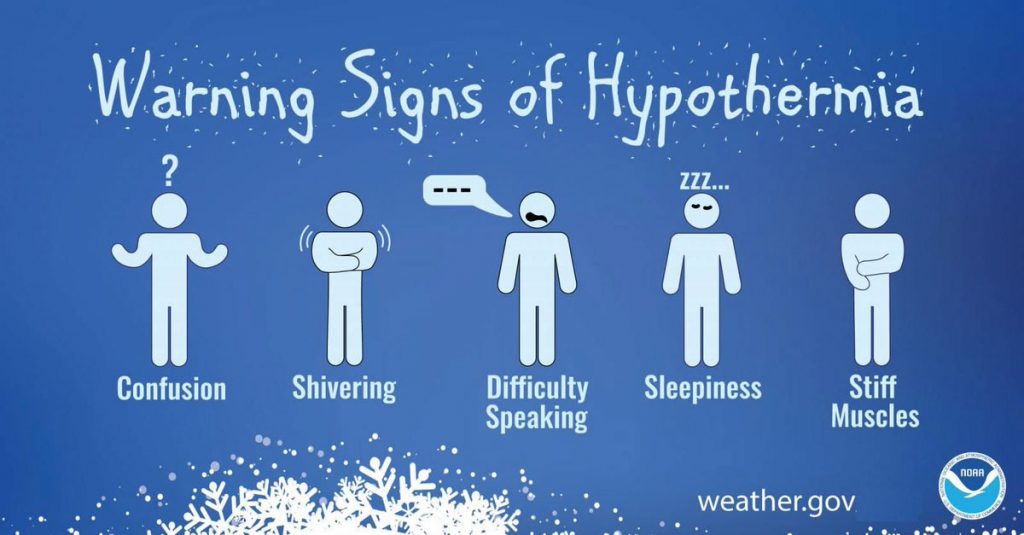
 occurs when body temperature falls below 95 degrees Fahrenheit. Visible warning signs include uncontrollable shivering, memory loss, disorientation, incoherence, slurred speech, drowsiness, and exhaustion.
The U.S. governments Occupational Safety & Health Administration (OSHA) recommended steps for a person suffering from hypothermia:
- Call 911 immediately in an emergency; otherwise seek medical assistance as soon as possible.
- Move the person to a warm, dry area.
- Remove wet clothes and replace with dry clothes, cover the body (including the head and neck) with layers of blankets; and with a vapor barrier (e.g. tarp, garbage bag). Do not cover the face.
- If medical help is more than 30 minutes away:
- Give warm sweetened drinks if alert (no alcohol), to help increase the body temperature. Never try to give a drink to an unconscious person.
- Place warm bottles or hot packs in armpits, sides of chest, and groin. Call 911 for additional rewarming instructions.
- If a person is not breathing or has no pulse:
- Call 911 for emergency medical assistance immediately.
- Treat the worker as per instructions for hypothermia, but be very careful and do not try to give an unconscious person fluids.
- Check him/her for signs of breathing and for a pulse. Check for 60 seconds.
- If after 60 seconds the affected worker is not breathing and does not have a pulse, trained workers may start rescue breaths for 3 minutes.
- Recheck for breathing and pulse, check for 60 seconds.
- If the worker is still not breathing and has no pulse, continue rescue breathing.
- Only start chest compressions per the direction of the 911 operator or emergency medical services*
- Reassess patients physical status periodically.
?