According to NOAA’s Spring Outlook released today, rivers in half of the continental United States are at minor or moderate risk of exceeding flood levels this spring with the highest threat in the southern Great Lakes region due to above-average snowpack and a deep layer of frozen ground. Additionally, drought is expected to continue in California and the Southwest.
The continuation of winter weather, above-average snowpack, frozen ground and thick ice coverage on streams and rivers will delay spring flooding into April in the upper Midwest eastward to New England. The intensity of the flooding will depend on the rate of snow and ice melt, and future rainfall.
Continued well-below average temperatures this winter resulted in significant river ice formation and ice jams in locations further south than customary, flooding homes and businesses, and impacting river commerce. There is also an elevated risk of more ice jams this spring in the northern tier of the U.S. from Montana eastward to northern New England.
“This year’s spring flood potential is widespread and includes rivers in highly populated areas putting millions of Americans at risk,” said Louis Uccellini, Ph.D., director, NOAA’s National Weather Service. “Although widespread major river flooding is not expected, an abrupt warming or heavy rainfall event could lead to isolated major flooding.”
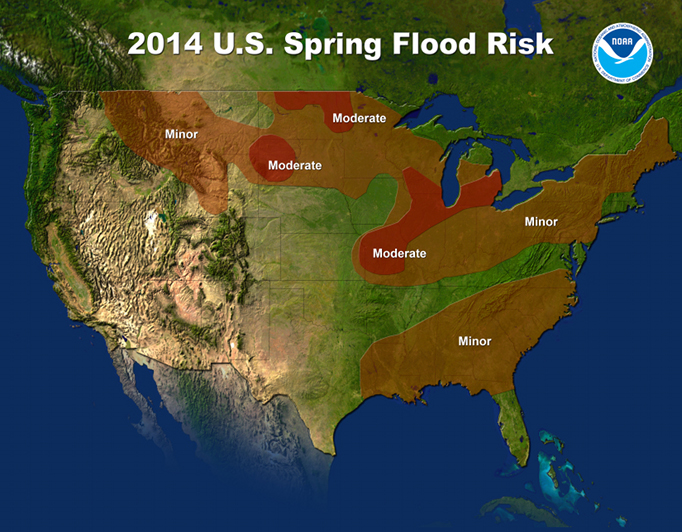
Spring Flood Risk
National Weather Service hydrologists predict moderate flooding in parts of southern Wisconsin, southern Michigan and portions of Illinois, Indiana, and Iowa as a result of the current snowpack and the deep layer of frozen ground coupled with expected seasonal temperatures and rainfall. At risk are the Mississippi River and the Illinois River as well as many smaller rivers in these regions. Small streams and rivers in the lower Missouri basin in Missouri and eastern Kansas have already experienced minor flooding this year and the threat of moderate flooding will persist through the spring.
There is a risk of moderate flooding along the Red River of the North between eastern North Dakota and northwest Minnesota, and along the Souris River below Minot, N.D. River ice, snowpack and significant frozen ground are factors in the flood risk for this area.
Additionally, there is a risk of moderate flooding for western South Dakota because of current saturated soils.
Minor flooding is likely in the northern Rockies, parts of the Midwest, and the Great Lakes region. Minor flooding is also possible in the Northeast, the lower Mississippi River basin, and across the entire Southeast up to Virginia, including east Texas, and parts of Arkansas, Tennessee, Kentucky, West Virginia and the Florida panhandle. In these areas, spring flood risk is highly dependent on rainfall.
Drought Outlook
Significant and widespread drought conditions continue in California which experienced its warmest and third driest winter on record. Drought is expected to persist or intensify in California, Nevada, most of interior Oregon and Utah, Arizona, New Mexico, southeast Colorado, western Oklahoma, and most of west Texas because of below-average rain or snow this winter and the onset of the dry season in April. If the drought persists as predicted in the West and Southwest, it will likely result in an active wildfire season, continued stress on crops and livestock due to low water levels, and an expansion of water conservation measures. Drought removal expected for the Big Island of Hawaii.
Drought improvement is likely in Washington, southeast Idaho, extreme northern and coastal Oregon, western and central sections of Nebraska and Kansas, central Oklahoma, and the Midwest. Drought is not expected east of the Mississippi River during the next three months.
More information about drought can be found at
www.drought.gov, a clearinghouse of drought-related materials managed by NOAA including maps, tools, and information to help prepare for and mitigate the effects of drought.
Temperature and Precipitation Outlook
Below-normal temperatures this spring are favored for an area from Montana eastward across the northern Plains to the Great Lakes region, while warmer-than-normal temperatures are most likely for western sections of Washington and Oregon, California, the desert Southwest, the southern Plains, the Southeast and all of Alaska.
For precipitation, odds favor drier-than-normal conditions for the Alaska panhandle, western Washington and Oregon, California and parts of Nevada and Arizona. Hawaii is favored to be both warmer and wetter than normal this spring.