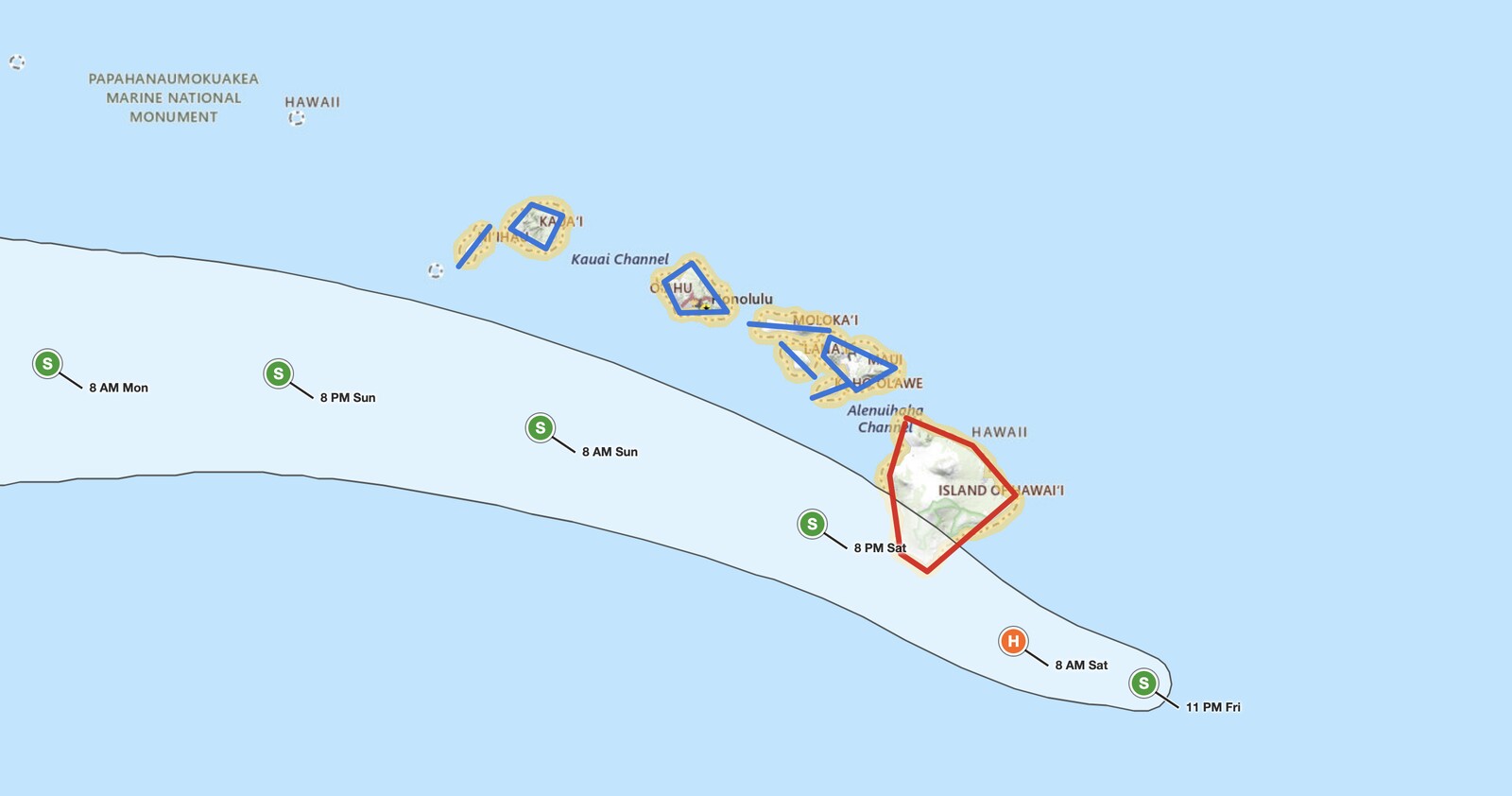
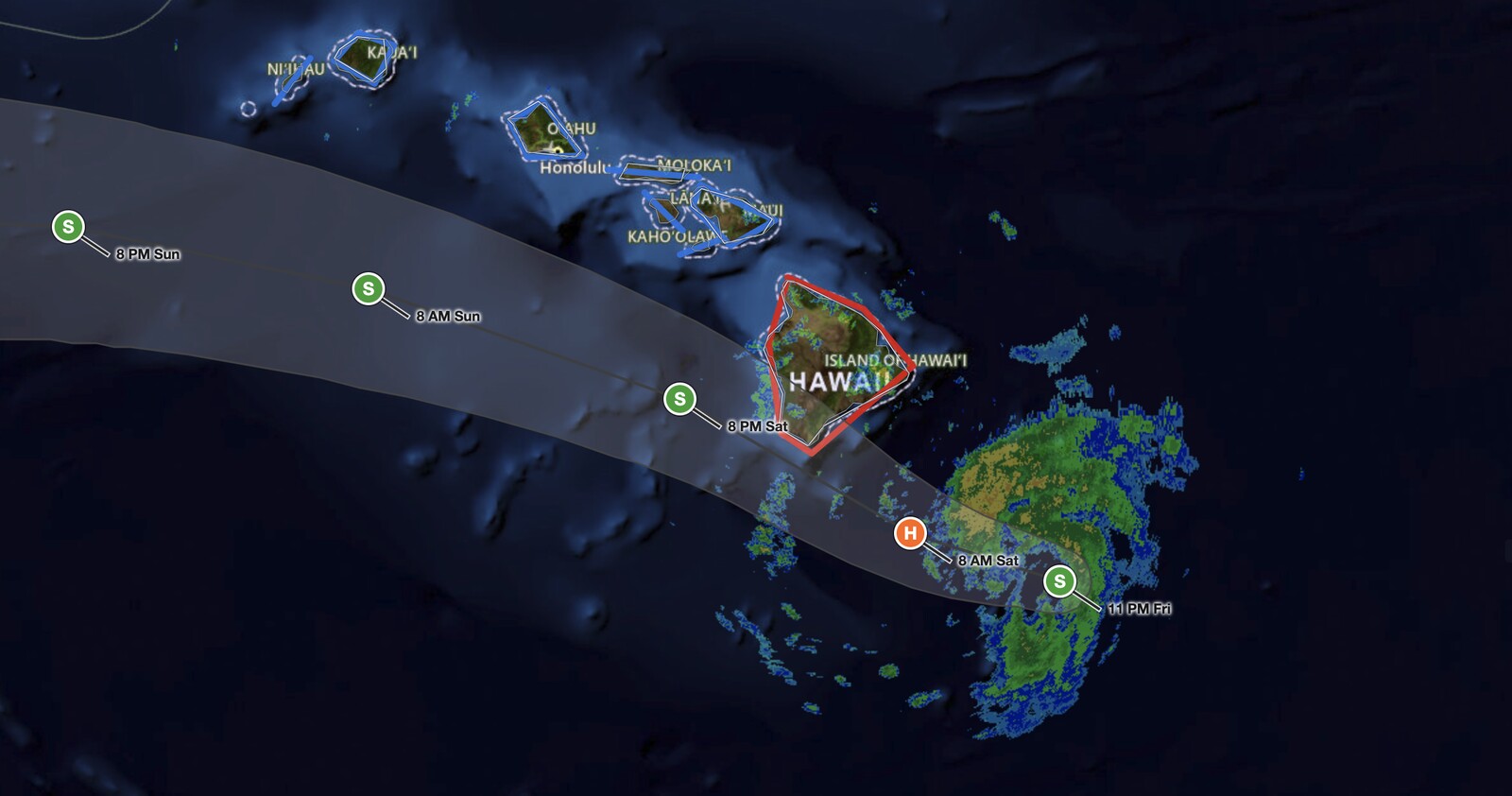
Hawaii Hurricane Lala is the storm the islands are now preparing for. The National Hurricane Center and Central Pacific Hurricane Center forecast hurricane conditions on the Big Island of Hawaii on Saturday, August 15, 2026, with tropical storm conditions spreading to Maui, Oahu, and Kauai through the weekend. As of Advisory 12, issued at 11:00 PM HST Friday, August 14, the system was still Tropical Storm Lala, centered about 165 miles east-southeast of South Point with maximum sustained winds of 65 mph, moving west-northwest at 13 mph and forecast to reach hurricane strength before its closest approach.
Key points:
- Hurricane Warning in effect for Hawaii County (the Big Island).
- Tropical Storm Warnings cover Maui County, Oahu, and Kauai County.
- Rainfall of 10 to 20 inches expected on the Big Island, up to 25 inches locally.
- Storm surge of 1 to 3 feet possible along Hawaii coastlines.
- Life-threatening flooding, mudslides, surf, and rip currents forecast this weekend.
Get Severe Weather Alerts for Your Location
When any NWS watch, warning, or advisory is issued for your area, iAlert sends you an immediate notification by email, text message, or phone call, 24 hours a day, 7 days a week.
Sign Up for Severe Weather Alerts →What Hawaii Hurricane Lala’s Track Means for Each Island
The advisory states that Lala’s core is expected to pass near South Point on the Big Island on Saturday before tracking south of the smaller islands on Sunday, August 16. That track puts Hawaii County closest to the storm center and therefore in the highest-hazard zone, which is why a Hurricane Warning rather than a Tropical Storm Warning is in effect there.
For Maui County, including the islands of Maui, Lanai, Molokai, and Kahoolawe, tropical storm conditions are expected Saturday night. Oahu and Kauai County, including Kauai and Niihau, are forecast to experience tropical storm conditions by Sunday morning. Interests in the Papahanaumokuakea Marine National Monument should monitor Lala’s progress as the storm continues west-northwest.
One detail worth flagging: the advisory notes that wind speeds on mountaintops and on windward and leeward slopes are often up to 30 percent stronger than the near-surface winds listed in the bulletin. With sustained winds already at 65 mph and strengthening expected before landfall, summit and ridge locations on the Big Island could see significantly higher gusts than the advisory headline figure suggests.
Rainfall, Storm Surge, and Surf From Hawaii Hurricane Lala
Rainfall is one of the most consequential threats from Hawaii Hurricane Lala this weekend. The advisory calls for 10 to 20 inches of rain on the Big Island, with isolated totals up to 25 inches possible. Maui is forecast to receive 8 to 12 inches, while the remaining islands in the chain could see 4 to 6 inches with maximums up to 8 inches. Forecasters characterize this rainfall as capable of producing life-threatening flooding and mudslides, especially in areas of steep terrain.
Along the coast, storm surge of 1 to 3 feet is forecast for Hawaii, with the advisory warning that the deepest inundation will occur along the immediate shoreline, where surge will be accompanied by large and dangerous waves. Swells generated by Lala are already building along east-facing shores and will continue increasing through the weekend. As the storm tracks south of the island chain, south-facing shores will begin building as well. The advisory describes the resulting surf and rip current conditions as likely to be life-threatening.
Meteorologist’s Take
Hawaii Hurricane Lala is a textbook example of a tropical system that intensifies as it approaches the islands. The official track carries Lala at hurricane strength at 8:00 AM HST Saturday, just southeast of the Big Island, and back to tropical storm strength by 8:00 PM HST that same evening. That is a narrow peak. It means conditions on the Big Island deteriorate quickly through Saturday morning rather than building gradually, and the window for outdoor preparation closes earlier than a slower-strengthening storm would allow.
The rainfall threat from Hawaii Hurricane Lala deserves as much attention as the wind. Hawaii’s volcanic topography funnels moisture into narrow valleys and steep slopes, where even moderate rainfall rates can trigger flash flooding and debris flows. Twenty-five inches of rain on terrain that drains quickly is a serious mudslide setup, independent of wind speed. Residents and visitors in low-lying coastal areas face the compounding threat of storm surge stacked on top of already elevated seas from Lala’s swell field, which has been building since before the storm’s closest approach.
From a forecasting standpoint, Maui, Oahu, and Kauai avoid the worst of Lala for one reason, and it is distance, not rain-band geometry. The forecast track keeps the center farther from those islands than from the Big Island, and both rainfall and surge fall off sharply with distance from the core. The other side of that is worth stating plainly: a west-northwest-moving system passing to the south leaves every island in the right-hand semicircle, which is the stronger-wind side of a Northern Hemisphere tropical cyclone. Lower rain totals do not mean lower wind. And 8 to 12 inches on Maui with up to 8 inches on Oahu and Kauai will flood urban drainages regardless of where the center tracks.
How to Stay Safe During Hawaii Hurricane Lala
If you are on the Big Island, preparations to protect life and property should be completed now, well before tropical-storm-force winds arrive. Once sustained tropical-storm winds begin, outdoor activity becomes dangerous and emergency response is limited.
Key actions for Hawaii Hurricane Lala conditions include staying off roads subject to flooding, moving away from streams and drainage channels that can rise rapidly, and staying well back from ocean shorelines where surge and life-threatening surf are forecast. On the Big Island, residents in low-lying coastal areas or steep-terrain neighborhoods should follow any evacuation guidance issued by Hawaii County Civil Defense.
For Maui, Oahu, and Kauai, tropical storm conditions are expected to arrive later in the weekend. Use the time remaining to secure outdoor objects, charge devices, and stock emergency supplies. Monitor your active weather alerts through iAlert so you receive any changes to warnings or new watch issuances without delay. You can also check the live radar and alerts to track Lala’s approach in real time.
Stay out of the ocean this weekend. Rip currents and large surf associated with Hawaii Hurricane Lala are forecast to be life-threatening along east-facing shores across the entire island chain, with south-facing shores building as the center passes to the south.
Hawaii Hurricane Lala FAQ
Which island faces the highest risk from Hawaii Hurricane Lala?
The Big Island of Hawaii faces the highest risk. A Hurricane Warning is in effect for Hawaii County, and the storm center is forecast to pass near South Point on Saturday, August 15.
How strong are Lala’s winds right now, and will they increase?
As of Advisory 12 at 11:00 PM HST Friday, maximum sustained winds are 65 mph. Steady strengthening is forecast, and the official track carries Lala at hurricane strength by 8:00 AM HST Saturday, southeast of the Big Island, before weakening back to a tropical storm Saturday evening.
What is the difference between the Hurricane Warning and the Tropical Storm Warning for Lala?
A Hurricane Warning means sustained winds of 74 mph or higher are expected within 36 hours, and it covers Hawaii County. A Tropical Storm Warning means sustained winds of 39 to 73 mph are expected, and it covers Maui County, Oahu, and Kauai County. The warning type reflects how close each island is to Lala’s forecast center.
When will tropical storm conditions reach Oahu and Kauai?
The advisory forecasts tropical storm conditions on Oahu and Kauai County by Sunday morning, August 16, after Lala passes near the Big Island on Saturday and tracks south of the smaller islands.
Sources:
Get Severe Weather Alerts for Your Location
When any NWS watch, warning, or advisory is issued for your area, iAlert sends you an immediate notification by email, text message, or phone call, 24 hours a day, 7 days a week.
Sign Up for Severe Weather Alerts →