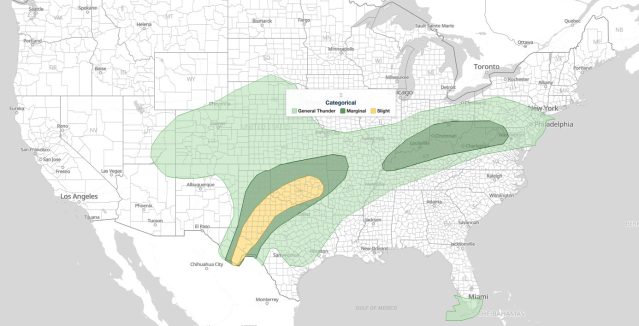
Northern Plains severe weather is in the forecast today, June 29, 2026, as the NOAA Storm Prediction Center has placed portions of the Dakotas, the Upper Midwest, and the Mid-Missouri Valley under a Slight Risk, the second of five severe categories (level 2 of 5). Large hail, damaging winds, and a few tornadoes are all possible through the day, with supercell thunderstorms the primary vehicle for these hazards.
Key points:
- Slight Risk (level 2 of 5) covers the northern Plains and Upper Midwest on June 29.
- Primary Northern Plains severe weather hazards: large to very large hail and damaging wind gusts.
- SPC tornado probability: 5%; large hail and damaging wind each at 15%.
- Elevated supercells likely ongoing early; additional storms expected near warm front into North Dakota and Minnesota.
- A couple of tornadoes are possible if storms become surface-based.
What the SPC Is Forecasting
The Storm Prediction Center’s Day 1 outlook, valid for June 29, 2026, identifies the core threat zone for this Northern Plains severe weather event as portions of the Dakotas, extending into Minnesota and the Upper Midwest, with a secondary focus back into the Mid-Missouri Valley and central Plains along a cold front. SPC uses a five-tier system to communicate severe weather potential, and you can review exactly what each category means through this iAlert guide to SPC outlook risk categories.
According to the SPC, elevated supercell activity is likely already ongoing at the start of the period near the surface low crossing the Dakotas, positioned near the nose of the low-level jet. As the day unfolds, a warm front is expected to push into North Dakota and Minnesota by afternoon, with additional storm development anticipated both near that boundary and back along the cold front. The SPC places the probability of large hail at 15 percent, damaging wind at 15 percent, and tornadoes at 5 percent within the risk areas.
Meteorologist’s Take
The trigger for today’s Northern Plains severe weather is a shortwave trough, a dip in the upper-level flow, advancing eastward out of the northern Rockies into the northern Plains. At the surface, a low-pressure center is tracking northward out of Nebraska into the Dakotas. Attached to that low is a cold front and dry line pushing southward and a secondary low developing across the central Plains. This combination creates a favorable corridor for organized, rotating thunderstorms known as supercells.
The environment features moderate to strong instability alongside deep-layer wind shear of around 45 to 50 knots, meaning winds are both strong and rapidly changing direction and speed with altitude. That combination is what helps thunderstorm updrafts rotate. Near the warm front in North Dakota and Minnesota, a plume of steep low-to-mid-level temperature lapse rates, meaning the atmosphere cools unusually fast with height, is expected to surge northward through the afternoon, adding fuel for any storms that develop there. The SPC notes that if afternoon storms become surface-based rather than elevated, they will be capable of producing all hazard types, including large to very large hail, severe wind gusts, and tornadoes.
The main forecast uncertainty centers on how the morning convection evolves. If early storms leave behind a stable air mass, afternoon development could be limited. If the atmosphere recovers, the warm-front and cold-front zones both become active corridors for supercell development, which is why the SPC has maintained the Slight Risk designation across a broad area of the northern Plains severe weather region.
How to Stay Safe from Northern Plains Severe Weather
The dominant threats for this Northern Plains severe weather event are large to very large hail and damaging winds, with a lower but real tornado risk. If you are in the Dakotas, Minnesota, or the Upper Midwest today, take the following steps matched to these specific hazards:
- Hail: Move vehicles into a garage or covered structure before storms arrive. Hail damage can happen within seconds once a supercell is overhead.
- Damaging winds: Stay away from windows and secure or bring in outdoor furniture, trampolines, and anything that can become a projectile. Downed trees and power lines are common after severe wind events.
- Tornadoes: Know your shelter location now: an interior room on the lowest floor of a sturdy building, away from windows. A basement is best.
- Stay informed: Storms can move fast across the northern Plains. Monitor live radar and active alerts throughout the afternoon and evening.
You can also check your personalized local weather forecast for the most up-to-date guidance for your specific location within the Northern Plains severe weather risk area. Supercell thunderstorms associated with Northern Plains severe weather can produce their worst hazards in a very short time window, so acting before storms arrive is far safer than reacting once they are on top of you.
Watch for any Severe Thunderstorm Warnings or Tornado Warnings issued by your local National Weather Service office throughout the day. The SPC outlook sets the stage, but official warnings are your action trigger. Sign up for iAlert weather alerts and notifications to receive real-time warnings for your location so you never miss a critical update.
Sources: