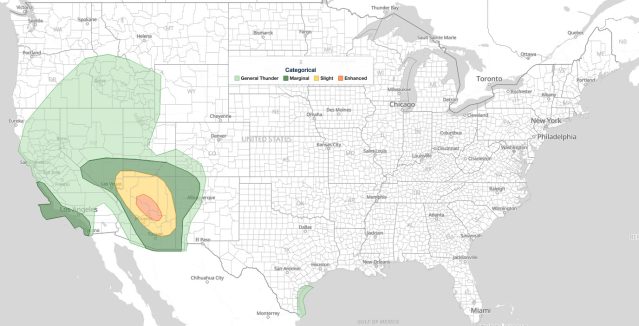
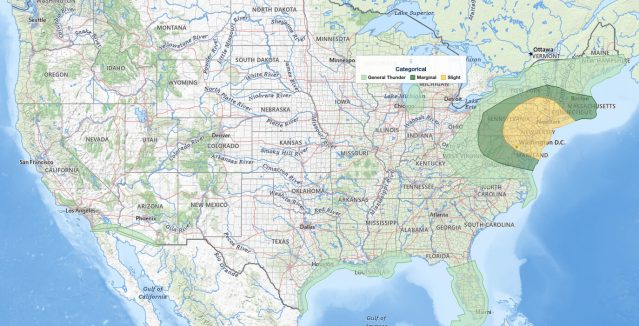
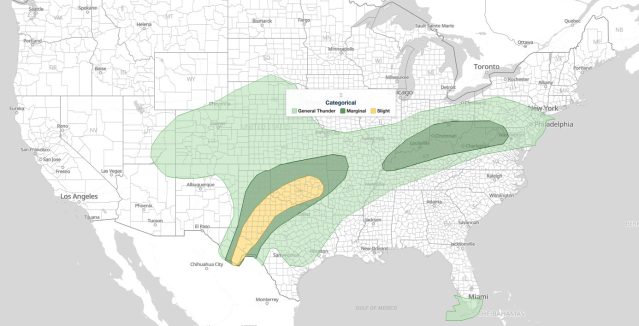
Montana severe thunderstorms are threatening the northern High Plains on June 27, 2026, with the NOAA Storm Prediction Center issuing an Enhanced Risk, the third of five severe categories (level 3 of 5), centered on eastern Montana and western North Dakota. SPC uses a five-tier system to communicate severe weather potential; see the SPC outlook risk categories explained for a full breakdown. Storms are expected to fire late this afternoon and continue into early tonight, bringing very large hail up to 2 to 3 inches in diameter, potentially destructive outflow winds exceeding 80 mph, and a limited tornado threat along the Montana and North Dakota border region.
Key points:
- Enhanced Risk (level 3 of 5) covers eastern Montana and western North Dakota.
- Hail up to 2 to 3 inches in diameter possible near the MT/ND border.
- MCS outflow winds of 80+ mph possible late evening into early tonight.
- Slight Risk (level 2 of 5) extends into western South Dakota, Nebraska, and North Carolina.
- SPC hazard probabilities: large hail 30%, damaging wind 30%, tornado 5%.
Where and When Montana Severe Thunderstorms Are Most Dangerous
Two main corridors will focus the Montana severe thunderstorms this afternoon: near the surface trough and lee cyclone close to the Montana and North Dakota border, and near the Big Horn Mountains in northern Wyoming. These initial storms carry the highest hail threat, with very large hail ranging from 2 to 3 inches in diameter possible near the ND/MT border. The SPC also notes a couple of tornadoes are possible with any supercells anchored along the surface boundary, though relatively large temperature-dewpoint spreads and uncertainty about storm mode could limit the tornado threat somewhat.
By late evening and early tonight, storms are forecast to grow upscale and sweep northeastward across North Dakota as one or more mesoscale convective systems, or MCSs. Those MCS complexes could produce severe outflow winds topping 80 mph. Farther south, more isolated supercells into western South Dakota and Nebraska carry a Slight Risk, the second of five severe categories (level 2 of 5), with isolated very large hail and significant severe wind gusts also possible in that corridor. North Carolina is under a separate Slight Risk for isolated wind damage this afternoon.
What Is Driving These Storms Across the Northern High Plains
A closed mid-level low sitting over the northern Great Basin and northern Rockies is organizing the Montana severe thunderstorms. Embedded speed maxima, essentially pockets of faster-moving air within the upper-level flow, are rotating northeastward around the eastern edge of that low and providing the wind shear needed to sustain supercell thunderstorms. At the surface, a deep lee trough and cyclone along the central and northern High Plains is helping draw boundary-layer moisture northward from Kansas and Nebraska into the Dakotas, with dewpoints reaching into the 60s Fahrenheit.
That moisture is streaming in beneath steep mid-level lapse rates, meaning the atmosphere cools very rapidly with height. Combined with daytime heating, this produces large Convective Available Potential Energy, or CAPE, which is the fuel that allows thunderstorms to grow tall, intense, and hail-producing. Early storms forming along the trough and near the Big Horn Mountains are likely to be discrete supercells, the storm mode most efficient at producing very large hail and tornadoes. As the evening progresses and the storm complex expands, storm mode is expected to shift toward MCS-type organization, which shifts the primary threat toward widespread, damaging straight-line winds.
Meteorologist’s Take
The setup for Montana severe thunderstorms today is textbook northern High Plains early summer. A closed upper-level low anchored over the northern Rockies is the key driver, spinning energy eastward and creating the wind shear profile supercells need to rotate. The steep lapse rates are the real wild card here: they are what allows hail to grow to baseball size or larger, and they are also what supercharges MCS outflow winds well into damaging territory once storms merge later tonight.
The tornado risk is real but tempered. Larger temperature-dewpoint spreads in the boundary layer limit low-level moisture quality, and the anticipated transition from discrete supercells to a more linear or clustered storm mode reduces the window for sustained tornado-producing circulations. That said, the 5 percent tornado probability from the SPC is not trivial near the ND/MT border this afternoon, especially before the storm mode transition occurs. The bigger story after sunset is likely the MCS wind threat pushing into North Dakota.
How to Stay Safe from Montana Severe Thunderstorms Today
If you are in eastern Montana, western North Dakota, western South Dakota, or Nebraska this afternoon and evening, the primary threats are very large hail and damaging winds. Hail at 2 to 3 inches in diameter can destroy vehicle glass, damage roofs, and injure anyone caught outdoors. Move vehicles under solid cover before storms arrive, and stay inside away from windows during any warning.
A tornado watch or warning is possible near the MT/ND border this afternoon. If a tornado warning is issued for your area, move immediately to an interior room on the lowest floor of a sturdy building. Keep a battery-powered or hand-crank weather radio nearby as power outages are possible with 80+ mph outflow winds. Stay informed by checking active weather alerts throughout the afternoon and evening, and set up push notifications through iAlert weather alerts and notifications so you are reached the moment a watch or warning is issued for your county.
Montana severe thunderstorms and their downstream impacts across the Dakotas and Nebraska will evolve quickly tonight. Keep a close eye on updated SPC outlooks and local National Weather Service statements as storm initiation timing becomes clearer through the afternoon hours.
Sources:
Get Severe Weather Alerts for Your Location
When any NWS watch, warning, or advisory is issued for your area, iAlert sends you an immediate notification by email, text message, or phone call, 24 hours a day, 7 days a week.
Sign Up for Severe Weather Alerts →