Wondering what a mesocyclone is, how a microburst differs from a macroburst, or what the North American Monsoon means for the Southwest? Trying to understand MCS weather or when the NWS issues a marine weather warning?
Jump to weather terms beginning with the letter:
A | B | C | D | E | F | G | H | I | J | K | L | M | N | O | P | Q | R | S | T | U | V | W | X | Y | Z
Get Severe Weather Alerts for Your Location
When any NWS watch, warning, or advisory is issued for your area, iAlert sends you an immediate notification by email or text, 24 hours a day, 7 days a week.
Sign Up for Severe Weather Alerts →Weather Terms Beginning with “M”
Macroburst
A macroburst is a large downburst with an outflow diameter of 2.5 miles or greater. It produces straight-line winds of 60-130 mph over an area several miles wide and lasts 5-30 minutes, longer and wider in impact than a microburst, though not necessarily faster. Macrobursts can level forests over several square miles. The July 1977 Teton-Yellowstone macroburst was one of the most extensively documented events, producing winds estimated at 150+ mph. On Doppler radar, a macroburst appears as a large area of divergent wind patterns distinct from the tight couplet signature of a tornado.
Marine Warning
A Marine Warning is a marine weather product issued by the NWS for coastal and inland waterways when hazardous conditions are occurring or expected. Types include Small Craft Advisory (15-33 knots), Gale Warning (34-47 knots), Storm Warning (48-63 knots), and Hurricane Force Wind Warning (64+ knots). The NWS also issues Hazardous Seas Warnings for dangerous wave heights independent of wind speed. Recreational boaters should check marine forecasts before departure and file a float plan. NOAA Weather Radio broadcasts marine forecasts continuously, and VHF Channel 16 is the emergency channel.
Mesocyclone
A mesocyclone is a rotating updraft within a supercell thunderstorm, the key structural feature that leads to significant tornado formation. The rotation originates in the wind shear of the environment: winds that change speed and direction with altitude create horizontal vortex tubes that are tilted upright by the thunderstorm’s powerful updraft. Mesocyclones are 1-6 miles in diameter and are identified on Doppler radar by a characteristic velocity “couplet”, a region of inbound winds directly adjacent to outbound winds. A persistent, well-organized mesocyclone is the primary precursor to significant tornado formation, and the NWS issues Tornado Warnings based in part on confirmed mesocyclone signatures. Read more: How Tornadoes Form and What is a Supercell?
Mesoscale Convective System (MCS)
A Mesoscale Convective System is a large cluster of organized thunderstorms that functions as a single weather system, spanning at least 60 miles in one direction. Types include Mesoscale Convective Complexes (MCC, a nearly circular cloud shield covering 40,000 or more square miles) and squall lines (linear). MCS events produce the majority of growing-season rainfall across the corn and wheat belts of the central US, making them critically important to agriculture. However, large MCS complexes can also produce derechos, widespread hail, embedded tornadoes, and flash flooding. They persist for 6-24 or more hours and can travel 1,000 or more miles overnight.
Microburst
A microburst is a small but intense downburst with an outflow diameter under 2.5 miles. It lasts under 5 minutes but produces winds of 60-150+ mph, extremely dangerous to aircraft during takeoff and landing phases. The 1985 Delta Air Lines Flight 191 crash at Dallas/Fort Worth was caused directly by a microburst. On Doppler radar, a microburst appears as a small area of rapidly diverging winds. The NWS issues Wind Shear Alerts for aviation when microburst potential is high near airports. “Dry microbursts” are especially dangerous because there is no visible rain shaft to warn pilots of the hazard below.
| Feature | Microburst | Macroburst | Derecho |
|---|---|---|---|
| Size | Under 2.5 mi diameter | 2.5+ mi diameter | 240+ mi damage path |
| Duration | Under 5 minutes | 5-30 minutes | Several hours |
| Peak Winds | 60-150+ mph | 60-130 mph | 58-100+ mph |
| Wind type | Diverging straight-line | Diverging straight-line | Straight-line along squall line |
| Storm type | Any convective storm | Strong thunderstorms | Organized MCS/squall line |
| Primary danger | Aviation, localized | Structures over wide area | Regional power/property damage |
Mixed Precipitation
Mixed precipitation is a precipitation type consisting of a combination of rain, freezing rain, sleet, and snow occurring in the same event. It is common when a surface temperature inversion creates a complex layered atmosphere with warm air aloft over cold surface air. Forecasting rain/snow/sleet boundaries is one of the most difficult challenges in operational meteorology, small changes in the depth of the warm layer can shift boundaries by dozens of miles. Roads during mixed precipitation events can have patchy ice (where sleet or freezing rain has fallen) alternating with wet sections (where rain fell), creating unpredictable and dangerous traction conditions that drivers do not anticipate.
Monsoon
A monsoon is a seasonal shift in wind direction that brings a dramatic change in precipitation. The term is most commonly applied in the US to the North American Monsoon (Southwest Monsoon), which draws moisture from the Gulf of Mexico and Gulf of California into the Desert Southwest, primarily Arizona, New Mexico, southern Nevada, and Utah, from mid-June through September. Daily afternoon and evening thunderstorms deliver 30-50% of Arizona’s annual rainfall during the monsoon season. Severe weather associated with the Southwest monsoon includes flash floods, dust storms (haboobs), microbursts, and dry lightning. Globally, the Asian Monsoon system affects more people than any other weather pattern on Earth.
Moderate Risk (SPC)
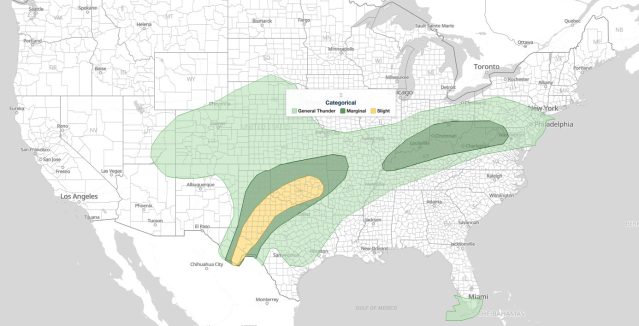
The Moderate Risk is the Storm Prediction Center’s third of five categorical risk levels for severe thunderstorm and tornado potential on their daily Convective Outlooks, above Slight Risk and below Enhanced Risk. It typically indicates a 5-15% probability of significant severe weather across a defined area. A Moderate Risk day covering a large metropolitan area will likely produce numerous severe thunderstorm reports, significant hail (2 or more inch diameter), damaging straight-line winds, and possibly strong tornadoes. Weather enthusiasts and storm chasers pay close attention to Moderate Risk days as reliable targets for significant severe weather documentation.
Mudslide (Debris Flow)
A mudslide, more precisely called a debris flow, is a rapid, channelized flow of saturated soil, rock, and organic material triggered by intense or prolonged rainfall saturating steep hillside soils, particularly after wildfire has removed stabilizing vegetation. Debris flows can travel at 15-35 mph and carry boulders and full-grown trees. They follow stream channels and drainage paths but can jump banks at bends, catching residents off guard. The January 2018 Montecito, California debris flow killed 23 people when heavy rain fell on the burn scar from the Thomas Fire. The NWS issues Flash Flood Warnings that specify “debris flow” threat when this hazard is present.
Meteorology
Meteorology is the scientific study of the atmosphere, its physical properties, and the processes that produce weather and climate. The word derives from the Greek “meteoron” meaning “atmospheric phenomenon.” Operational meteorologists (weather forecasters) work for the NWS, private companies, television stations, and aviation. Research meteorologists study atmospheric dynamics, radar, climate, and severe weather. The World Meteorological Organization (WMO) coordinates global weather observation, data sharing, and forecast standards. Modern operational meteorology relies on numerical weather prediction (NWP) computer models, Doppler radar, satellite imagery, and weather balloon data to produce increasingly accurate forecasts.
Millibar (mb)
The millibar is the unit of atmospheric pressure used in meteorological practice. It equals 1/1000 of a bar, and since 1 millibar equals 1 hectopascal, the two units are interchangeable. Standard sea-level pressure is 1013.25 mb. Pressure values in surface weather analysis maps are shown in millibars. Tropical storm central pressures below 940 mb indicate Category 4-5 hurricane intensity, the lower the pressure, the stronger the storm. The record lowest sea-level pressure in the Atlantic basin was 882 mb in the 1935 Labor Day Hurricane; the eastern Pacific record of 872 mb was set by Hurricane Patricia in 2015.
Marine Layer
A marine layer is a shallow layer of cool, moist air that forms over a cold ocean surface and is capped by a temperature inversion. It produces persistent low clouds, fog, and drizzle along coastlines, especially along the US West Coast, where cold upwelled Pacific water chills the overlying air. The Southern California marine layer produces the phenomenon known as “June Gloom.” Marine layers are typically 500-2,000 feet deep. They move onshore at night and in the morning, then retreat or “burn off” as afternoon heating warms the surface. Stronger marine layers can persist all day and suppress afternoon thunderstorm development in coastal areas.
Severe Weather Alerts, Any Location, Any Time
From a Marine Warning to a Tornado Warning, iAlert monitors every NWS alert and notifies you the moment one is issued for your area. Set up alerts for home, work, school, or anywhere your family is.
Get Weather Alerts →Frequently Asked Questions, “M” Weather Terms
What is a mesocyclone?
A mesocyclone is a rotating column of air within a supercell thunderstorm, the key structural feature that can lead to tornado formation. It forms when wind shear in the environment (winds changing speed and direction with altitude) creates horizontal spinning air tubes that get tilted upright by the thunderstorm’s strong updraft. A mesocyclone is 1-6 miles across and is detected on Doppler radar by a distinctive velocity couplet, a region of inbound winds adjacent to a region of outbound winds. When a persistent mesocyclone tightens and intensifies near the ground, a tornado becomes likely.
What is a microburst and why is it dangerous for aircraft?
A microburst is a small, intense downburst (under 2.5 miles wide) that produces winds of 60-150+ mph in a burst lasting under 5 minutes. It is most dangerous to aircraft during takeoff and landing because pilots encounter a sudden headwind as they approach the burst, then a violent tailwind as they pass through it, causing an extreme and rapid loss of airspeed and lift. Several airline crashes have been directly attributed to microburst wind shear. Doppler radar at major airports provides wind shear alerts, and modern airline procedures require an immediate go-around when wind shear is detected on approach.
What is a Mesoscale Convective System (MCS)?
A Mesoscale Convective System is a large, organized cluster of thunderstorms that functions as a coherent weather system, spanning at least 60 miles in one direction. MCS events include squall lines and Mesoscale Convective Complexes. They produce the majority of growing-season rainfall across the corn and wheat belts of the central US, making them critically important to agriculture. However, large MCS events can also produce derechos, widespread hail, flash flooding, and embedded tornadoes. They can persist for 12-24 or more hours and travel hundreds of miles overnight while most people are asleep.
What is the North American Monsoon?
The North American Monsoon is a seasonal shift in wind patterns that begins in mid-June and runs through September, drawing moisture from the Gulf of California and Gulf of Mexico northward into the Desert Southwest, primarily Arizona, New Mexico, southern Nevada, and Utah. This moisture fuels daily afternoon and evening thunderstorms that deliver 30-50% of Arizona’s annual rainfall in just three months. The monsoon also brings flash floods, haboobs (dust storms from thunderstorm outflows), microbursts, and lightning. Despite being called a “monsoon,” it is far less intense than Asian monsoon systems but critically important to the water supply of the Southwest.
What is mixed precipitation and why is it so difficult to forecast?
Mixed precipitation occurs when rain, freezing rain, sleet, and snow fall together in the same event, driven by a complex layered atmosphere with warm air sandwiched above and below freezing layers. Forecasting exactly where rain-snow-sleet-freezing rain boundaries fall is one of the hardest challenges in meteorology because the boundaries can shift dozens of miles based on small changes in the warm air layer’s thickness. During mixed precipitation events, roads can have patches of black ice (from freezing rain) immediately adjacent to wet pavement (from rain), creating sudden and dangerous changes in traction that drivers do not expect.
What is the Storm Prediction Center’s Moderate Risk?
The Storm Prediction Center (SPC) issues daily Convective Outlooks with five risk categories: Marginal, Slight, Enhanced, Moderate, and High. A Moderate Risk, the third highest level, means there is a 5-15% probability of significant severe weather, including the potential for intense tornadoes, large hail (2 or more inches), and damaging straight-line winds over a defined region. Moderate Risk days reliably produce numerous severe weather reports and often spawn significant tornadoes. The SPC typically issues a Moderate Risk when the atmospheric setup includes strong wind shear, high instability, and a clear trigger mechanism.
Never Miss a Severe Weather Alert
iAlert monitors National Weather Service watches, warnings, and advisories around the clock and sends you an immediate notification the moment your area is threatened. Works for any U.S. location.
View All Alert Services → Severe Weather Alerts →Related Articles
- Get real-time Severe Weather Email & Text Alerts
- What is a Supercell Thunderstorm?
- How Tornadoes Form
- Tornado Facts
- What is a Derecho?
- Understanding Hail
- Thunderstorm Basics: Structure, Types, and Forecasting
- Criteria for a Severe Thunderstorm Warning
- Criteria for a Tornado Warning
- Learn About Wildfires, Your Risk, and How to Prepare
- Understanding the NWS Severe Weather Outlook
- WxData.com, Weather Data API for apps and systems