Wondering what a nor’easter is, how it differs from a blizzard, or what the National Weather Service and NHC hurricane center actually do?
Jump to weather terms beginning with the letter:
A | B | C | D | E | F | G | H | I | J | K | L | M | N | O | P | Q | R | S | T | U | V | W | X | Y | Z
Get Severe Weather Alerts for Your Location
When any NWS watch, warning, or advisory is issued for your area, iAlert sends you an immediate notification by email or text, 24 hours a day, 7 days a week.
Sign Up for Severe Weather Alerts →Weather Terms Beginning with “N”
National Weather Service (NWS)
The National Weather Service is the primary federal agency responsible for weather, hydrologic, and climate forecasts and warnings for the United States. It is a branch of NOAA (National Oceanic and Atmospheric Administration) within the Department of Commerce. The NWS operates 122 Weather Forecast Offices (WFOs) across the country plus 13 River Forecast Centers and several specialized national centers, including the Storm Prediction Center in Norman, Oklahoma; the National Hurricane Center in Miami, Florida; and the Weather Prediction Center in College Park, Maryland. The NWS issues all official watches, warnings, and advisories; data and forecasts are freely available at weather.gov.
National Hurricane Center (NHC)
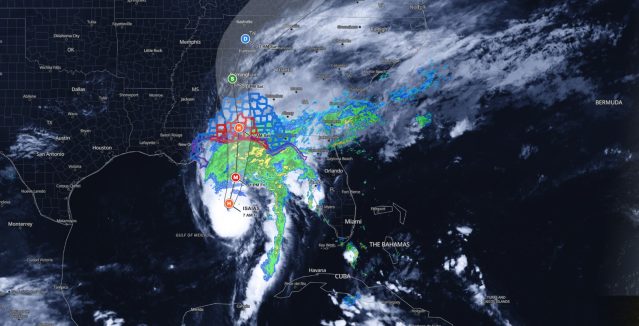
The National Hurricane Center is the specialized NWS center in Miami, Florida responsible for tracking and forecasting tropical cyclones in the Atlantic basin (including the Gulf of Mexico and Caribbean) and the eastern Pacific. The NHC issues Tropical Weather Outlooks, Tropical Storm and Hurricane Watches and Warnings, and the official 5-day forecast track “cone.” It also oversees the Central Pacific Hurricane Center (CPHC) for the central Pacific. The NHC’s Public Advisories, Forecast/Advisory products, and Storm Surge Watches and Warnings are the authoritative source for hurricane information. The NHC also issues wind speed probabilities used in evacuation planning. See also: About the National Hurricane Center and How to Use the NHC Cone Graphic.
NHC Forecast Cone (Cone of Uncertainty)
The NHC forecast cone is the shaded area on National Hurricane Center track forecast maps showing the probable track of a tropical cyclone’s center over the next 5 days. The cone is NOT the area of expected impact, wind, rain, and storm surge effects can extend far outside the cone. The cone is sized to encompass approximately 67% of historical track forecast errors, meaning roughly one-third of past storms tracked outside it. A storm can strike anywhere within or outside the cone. Residents should focus on local storm surge, wind, and rainfall watches and warnings issued by their local NWS office rather than on the cone’s centerline track.
NOAA Weather Radio (NWR)
NOAA Weather Radio is a nationwide network of radio stations broadcasting continuous NWS weather information at frequencies between 162.400 and 162.550 MHz. NWR provides warnings, watches, advisories, forecasts, and other hazard information 24 hours a day, 7 days a week. Specially programmed receivers automatically sound an alarm during watches and warnings, even at 3:00 AM when people are asleep, making NWR an essential tool for overnight severe weather. The NWS considers NWR the “voice of the NWS.” Battery-powered NWR receivers are standard emergency preparedness recommendations for homes in tornado-prone and hurricane-prone areas.
NOAA (National Oceanic and Atmospheric Administration)
NOAA is the federal science agency within the Department of Commerce responsible for conditions in the oceans and atmosphere. Its operational arms include the National Weather Service, National Hurricane Center, Storm Prediction Center, National Centers for Environmental Prediction (NCEP), National Ocean Service, and NOAA Fisheries. NOAA operates the GOES weather satellite constellation and a fleet of research aircraft, including the “Hurricane Hunters” WP-3D Orion aircraft that fly directly into tropical storms and hurricanes to gather data. NOAA also funds and conducts basic atmospheric and oceanic research that underpins weather forecast improvements.
Nor’easter
A nor’easter is a powerful extratropical cyclone that tracks along the eastern US coast, drawing its name from the northeasterly (NE) winds it produces along the coast as it passes. Nor’easters are characterized by heavy snow, ice, and rain depending on location; coastal flooding and beach erosion from powerful waves; and sustained winds of 40-80+ mph. Nor’easters are most intense from October through April. The greatest snowstorms in the history of Boston, New York, Philadelphia, and Washington DC have all been nor’easters. Unlike a blizzard, which requires visibility under 1/4 mile and sustained winds of 35+ mph for 3 or more consecutive hours, “nor’easter” is a geographic and storm-track term, not a NWS warning category. A nor’easter can also qualify for a Blizzard Warning if it meets blizzard criteria. Read more: What is a Nor’easter?, full article.
Nor’easter vs Blizzard, Key Differences
| Feature | Nor’easter | Blizzard |
|---|---|---|
| Definition type | Geographic/meteorological | NWS warning classification |
| Key characteristic | Storm tracking NE along the coast | Visibility under 1/4 mi + 35+ mph winds for 3+ hours |
| Precipitation | Heavy snow, ice, rain (varies by location) | Any snowfall amount, wind is the key factor |
| Wind | 40-80+ mph | 35+ mph sustained |
| Location | Primarily East Coast | Anywhere in US |
| Can they overlap? | Yes, a nor’easter can be issued a Blizzard Warning | Yes, the same storm can be a nor’easter AND a blizzard |
Nowcast
A nowcast is a very short-range weather forecast or hazard notification focused on the next 0-6 hours. NWS nowcast products include Special Weather Statements, Short-Term Forecasts, and local storm alerts that provide specific location-based information on approaching severe weather. Nowcasts are often generated automatically from radar algorithms or issued manually by NWS forecasters during fast-moving severe weather events. They are the most time-critical weather information product issued by the NWS, providing actionable, specific guidance when a storm is minutes to a few hours away.
Numerical Weather Prediction (NWP)
Numerical Weather Prediction is computer-based weather forecasting that uses mathematical equations to simulate the behavior of the atmosphere. Modern NWP models include the Global Forecast System (GFS), the European Centre for Medium-Range Weather Forecasts model (often called “the Euro”), the North American Mesoscale Model (NAM), and the High-Resolution Rapid Refresh (HRRR). NWP skill has improved dramatically over the decades, today’s 7-day forecast is as accurate as a 3-day forecast was in the 1980s. The ECMWF model famously outperformed US models in tracking Hurricane Sandy’s unusual westward turn in 2012, a turning point that led to major investment in improving American NWP capabilities.
NEXRAD (WSR-88D)
NEXRAD is the network of 160 Doppler weather radars operated across the US by the NWS, FAA, and Department of Defense. The name is short for Next Generation Weather Radar. The “88D” designation means the radar design was completed in 1988 and uses Doppler technology. The network was upgraded with dual-polarization capability between 2011 and 2013, significantly improving precipitation type discrimination and rain rate estimates. NEXRAD provides real-time precipitation estimates, wind velocity data, and storm-tracking information. Scan data is freely available on weather.gov and in numerous weather apps; individual radars have a range of about 250 miles for precipitation detection.
Winter Storm Watch / Blizzard Watch (Nor’easter Context)
When a potential nor’easter is 24-48 hours away, the NWS issues Winter Storm Watches or Blizzard Watches for coastal areas in the storm’s probable path. These are upgraded to Warnings when the storm’s track becomes more certain, typically 12-24 hours before onset. The track of a nor’easter is highly sensitive to small variations in the storm’s position: a storm that tracks 50-100 miles farther offshore than forecast produces significantly less snowfall at the coast. This sensitivity makes nor’easter snow forecasting notoriously challenging and is why early-watch snowfall ranges are often wide. Residents should prepare for the higher end of the forecast range during a nor’easter watch.
Severe Weather Alerts, Any Location, Any Time
From a nor’easter Winter Storm Warning to a Blizzard Warning, iAlert monitors every NWS alert and notifies you the moment one is issued for your area. Set up alerts for home, work, school, or anywhere your family is.
Get Weather Alerts →Frequently Asked Questions, “N” Weather Terms
What is a Nor’easter?
A nor’easter is a powerful coastal storm that tracks up the eastern US seaboard, producing northeasterly winds along the coast (hence the name). Nor’easters bring heavy snow, rain, ice, coastal flooding, and winds of 40-80+ mph depending on proximity to the storm’s center. The largest snowstorms in the history of Boston, New York, Philadelphia, and Washington DC have all been nor’easters. Unlike a blizzard, which is a specific NWS warning classification requiring visibility under 1/4 mile and 35+ mph winds for 3 or more consecutive hours, “nor’easter” is a geographic term for the storm’s track. A nor’easter can also receive a Blizzard Warning if it meets blizzard criteria.
What is the difference between a nor’easter and a blizzard?
A nor’easter is a type of East Coast storm defined by its track along the coast and the direction it drives winds from (the northeast). A blizzard is a NWS warning classification defined by specific measurable conditions: visibility under 1/4 mile combined with sustained winds or frequent gusts of 35+ mph lasting 3 or more consecutive hours. A nor’easter can trigger Blizzard Warnings if it produces these conditions, but not every nor’easter reaches blizzard criteria, some are primarily rain or light snow storms. Conversely, blizzards can occur far from the coast on the Plains with no nor’easter involvement.
What is NOAA Weather Radio and why is it important?
NOAA Weather Radio (NWR) is a network of stations broadcasting continuous NWS forecasts, watches, warnings, and advisories on dedicated frequencies around 162.4-162.55 MHz. Specially programmed NWR receivers include an alerting function that wakes a sleeping receiver and sounds an alarm when a watch or warning is issued for your area, even at 3:00 AM when you’re asleep. This makes NWR one of the most reliable ways to receive life-saving severe weather warnings overnight. Battery-powered NWR receivers are standard emergency preparedness recommendations for homes in tornado and hurricane-prone areas.
What is the National Hurricane Center’s cone of uncertainty?
The NHC forecast cone shows the probable track of a hurricane’s CENTER over the next 5 days, it is NOT the area of expected damaging wind, rain, or storm surge. The cone is sized to contain about 67% of historical track forecast errors, meaning one-third of hurricanes in the past have tracked outside the cone. Dangerous conditions can and do extend far outside the cone. Residents anywhere in the path should follow local NWS watches and warnings for their specific hazards, storm surge, wind speed, and rainfall, rather than focusing solely on whether the cone’s center track goes over their area.
What is Numerical Weather Prediction?
Numerical Weather Prediction (NWP) uses powerful computers to solve complex mathematical equations that simulate how the atmosphere behaves over time. Starting with current observations from weather balloons, radar, satellites, and surface stations, NWP models project the atmospheric state forward in time. The major models include the American GFS, the European ECMWF (often called “the Euro”), and the high-resolution HRRR model used for short-range forecasting. NWP skill has improved enormously, today’s 7-day forecast is as accurate as a 3-day forecast was in the 1980s. Forecasters blend multiple model outputs with their own expertise to generate official NWS forecasts.
What does the Storm Prediction Center do?
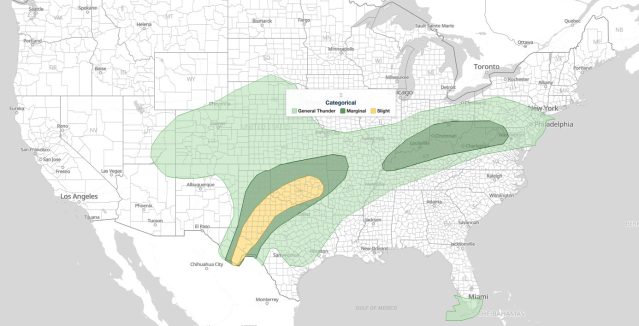
The Storm Prediction Center (SPC) in Norman, Oklahoma is a national NWS center that monitors severe convective weather and issues products used across the entire country. Its primary products include: the daily Convective Outlook (categorizing severe weather risk from Marginal through High); Severe Thunderstorm Watches and Tornado Watches (covering large multi-county areas for 4-8 hours when conditions are favorable for severe storms); Mesoscale Discussions (real-time analysis when severe weather is imminent or ongoing); and Day 3-8 Outlooks for extended severe weather potential. The SPC monitors atmospheric data 24/7, 365 days a year.
Never Miss a Severe Weather Alert
iAlert monitors National Weather Service watches, warnings, and advisories around the clock and sends you an immediate notification the moment your area is threatened. Works for any U.S. location.
View All Alert Services → Severe Weather Alerts →Related Articles
- Get real-time Severe Weather Email & Text Alerts
- What is a Nor’easter?
- About the National Hurricane Center
- How to Use the NHC Forecast Cone Graphic
- NOAA 2025 Atlantic Hurricane Season Forecast
- Know the Hurricane Hazard Terms
- Winter Storms, A Preparedness Guide
- Criteria for a Severe Thunderstorm Warning
- Understanding the NWS Severe Weather Outlook
- NOAA Tsunami Research
- WxData.com, Weather Data API for apps and systems