Wondering about a rip current warning, how to survive a rip current, or what the rain shadow effect does to precipitation? Need relative humidity explained or want to understand what NEXRAD radar actually shows?
Jump to weather terms beginning with the letter:
A | B | C | D | E | F | G | H | I | J | K | L | M | N | O | P | Q | R | S | T | U | V | W | X | Y | Z
Get Severe Weather Alerts for Your Location
When any NWS watch, warning, or advisory is issued for your area, iAlert sends you an immediate notification by email or text, 24 hours a day, 7 days a week.
Sign Up for Severe Weather Alerts →Weather Terms Beginning with “R”
Radar (Weather Radar / NEXRAD)
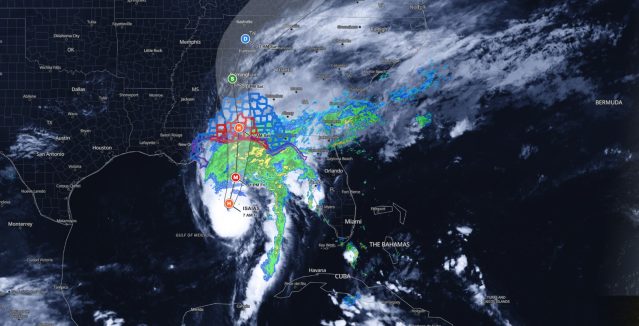
Radar stands for Radio Detection And Ranging. Weather radar sends pulses of microwave energy into the atmosphere and detects the energy returned by precipitation. The WSR-88D (NEXRAD) network of 160 Doppler radars operated by the National Weather Service provides real-time data on precipitation intensity, storm motion, and wind velocity across the continental United States. Dual-polarization capability, added to the full network between 2011 and 2013, allows forecasters to discriminate between rain, hail, snow, and non-meteorological returns such as insects and birds. Base reflectivity shows precipitation intensity in colors ranging from green (light rain) to red and purple (heavy rain and hail). Velocity (Doppler) products reveal wind motion toward or away from the radar site, allowing meteorologists to identify rotation inside thunderstorms before a tornado forms. The correlation coefficient product identifies precipitation type and detects tornado debris signatures. Real-time NEXRAD data is freely available at weather.gov. See: Your Local Weather Radar, Live Doppler Radar.
Rain Band
A rain band is a band of enhanced precipitation surrounding a tropical cyclone or associated with a frontal system. In tropical systems, outer rain bands can produce heavy rainfall, gusty winds, and tornadoes hundreds of miles ahead of the center, giving little warning before a hurricane’s core arrives. The innermost rain band wrapping around the eyewall is the most intense, capable of sustained winds near the maximum sustained wind speed of the storm. In extratropical cyclones, warm-sector rain bands and dry-slot intrusions create distinctive spiral patterns visible on satellite and radar imagery. Individual rain bands in a tropical system can produce 5-10 inches of rain in a matter of hours, accounting for a large share of the storm’s total flood damage well outside the area of strongest winds.
Rain Shadow
The rain shadow is the dry zone on the leeward (downwind) side of a mountain range where the orographic effect dramatically reduces precipitation. As moist air is forced up the windward slopes, it cools, condenses, and loses its moisture through precipitation. The now-dry air descends on the lee side, warming by compression and arriving at the surface hot and arid, a process called foehn warming. The contrast can be extreme: the Hoh Rain Forest on the Olympic Peninsula in Washington State receives over 140 inches of precipitation annually, while the eastern Cascades foothills just 60 miles away receive under 15 inches. The Great Basin, Mojave Desert, and Nevada’s arid interior exist largely in the rain shadow of the Sierra Nevada and Cascade ranges. The eastern slopes of the Rocky Mountains, the Patagonian steppe of Argentina, and the Atacama Desert of Chile are among the world’s other major rain shadow environments.
Relative Humidity (RH)
Relative humidity is the ratio of the actual amount of water vapor in the air to the maximum amount it could hold at that temperature, expressed as a percentage. When RH reaches 100%, the air is saturated, the dew point equals the air temperature and condensation occurs. The critical limitation of relative humidity as a comfort indicator is that it changes with temperature even when no moisture is added or removed. Warm air can hold far more water vapor than cold air, so RH drops as temperature rises on the same morning. A 100°F day at 20% RH feels oppressively dry but still dangerously hot; 75°F air at 100% RH feels clammy and suffocating despite the lower temperature. For this reason, the National Weather Service uses dew point, not relative humidity, as its primary moisture metric in forecasts, because dew point stays constant as temperature changes and more directly reflects how humid the air actually feels. See also: Relative Humidity Calculator.
Ridge (High Pressure Ridge)
A ridge is an elongated area of relatively high atmospheric pressure extending outward from an anticyclone (high pressure center), analogous to a mountain ridge on a topographic map. Ridges are characterized by sinking air, clear skies, and warm, dry conditions. The jet stream is displaced poleward over a ridge, steering storm systems away from the affected area. Persistent ridges create heat waves, drought, and poor air quality due to reduced vertical mixing that traps pollutants near the surface. The “Ridiculously Resilient Ridge” (often called the RRR) that dominated the eastern Pacific from roughly 2012 to 2015 blocked storm systems from reaching California and contributed directly to the historic multi-year drought. In the upper-level flow pattern, ridges alternate with troughs, a trough brings cold air and storms; a ridge brings warmth and drought.
Rip Current
A rip current is a strong, narrow, fast-moving channel of water flowing from the shoreline back out through the surf zone and beyond the breaking waves. Rip currents form when waves push water onto the beach and it returns seaward through the path of least resistance, typically a gap in a sandbar, near a jetty, pier, or through a break in submerged offshore features. Flow speeds typically reach 1-2 mph but can exceed 8 mph, faster than an Olympic swimmer can sustain. Rip currents are responsible for approximately 100 beach drowning deaths per year in the United States and account for 80% of all lifeguard rescues. They are frequently mistaken for the mythical “undertow”, a current that supposedly pulls swimmers beneath the surface. Rip currents do not pull people underwater; they pull people away from shore. A swimmer caught in a rip current who panics and tries to swim directly back to shore against the current will exhaust themselves. The correct response is to swim parallel to the shoreline, across the narrow current, until free of it, then angle back to the beach. Read our full safety guide: Rip Current Safety.
Rip Current Warning
A Rip Current Warning is issued by the National Weather Service when the risk of rip currents is high and the chance of rip current-related drowning is elevated. The warning is based on wave height, wave period (time between waves), the angle of waves approaching the shoreline, and wind direction, all of which influence how rip currents form and strengthen. Warnings are issued at the beach zone level and are product-specific to coastal forecast offices. When a Rip Current Warning is in effect, the water is considered dangerous and beach-goers should exercise extreme caution or stay out of the water entirely. The survival tip: if caught in a rip current, do not fight it by swimming directly toward shore, that leads to exhaustion and drowning. Swim parallel to the shoreline until free of the narrow current, then angle diagonally back to the beach. If you cannot escape, float and signal for help. Never swim alone at any beach, regardless of warning status.
Coastal Hazard Alert Types
| Alert Type | Trigger | Primary Hazard | Action |
|---|---|---|---|
| Rip Current Warning | High rip current risk from waves/swell | Sudden offshore pull | Swim parallel to shore if caught; heed all flags |
| High Surf Advisory | Waves 8-14 feet (varies by region) | Dangerous breaking waves | Stay off rocks and jetties; avoid wading |
| High Surf Warning | Waves 15+ feet (varies by region) | Extremely dangerous surf | Stay off all beaches; stay well back from water |
| Coastal Flood Advisory | Minor flooding of low-lying areas | Flooding of roads, parking lots | Move vehicles; use alternate routes |
| Coastal Flood Warning | Moderate to major coastal flooding | Property damage, road closures | Evacuate if ordered; move to higher ground |
Rime Ice
Rime ice forms when supercooled water droplets in fog or freezing drizzle freeze on contact with a surface, growing into white, granular, opaque deposits. It is distinct from glaze ice (clear, smooth, formed from freezing rain) and from clear ice (transparent, dense, formed in specific aircraft icing conditions). Rime ice comes in two forms: soft rime consists of white, feather-like crystals that grow into the wind on trees, power lines, and structures, and is the type that creates frost-like coatings on vegetation; hard rime is denser, more compact, and gray-white in appearance. Rime ice is a serious aviation hazard because it builds up on the leading edges of wings and propellers when aircraft fly through supercooled fog or clouds, disrupting aerodynamics and reducing lift. On roads and bridges, rime ice creates a white, opaque coating that is slightly less slippery than clear glaze ice from freezing rain but still very hazardous, particularly on elevated surfaces where the coating is not always obvious to drivers.
River Flood Warning
A River Flood Warning is issued by the National Weather Service when a river or stream is expected to exceed its flood stage, the level at which flooding begins to affect property, or is currently above flood stage. NWS River Forecast Centers categorize river flooding into four stages: Action Stage (prepare now; monitor closely), Minor Flood Stage (some inundation of low-lying areas and minor road closures), Moderate Flood Stage (some structures inundated and road closures affecting evacuation), and Major Flood Stage (extensive inundation of structures and roads with evacuations likely). River levels are continuously monitored by the USGS and NWS stream gauge network of thousands of sensors. Flood crest forecasts issued by NWS River Forecast Centers give emergency managers lead time to plan road closures, sandbagging operations, and evacuations. Never drive through flooded roadways, just 6 inches of fast-moving water can knock a person down; 12 inches can sweep a small vehicle off a road.
Rossby Waves (Planetary Waves)
Rossby waves are large-scale, atmospheric waves in the upper-level westerly flow driven by the rotation of the Earth and the conservation of angular momentum. They are characterized by extremely long wavelengths, spanning thousands of miles, and relatively slow eastward propagation. Rossby waves are responsible for the northward and southward meanders of the jet stream that steer weather systems across the mid-latitudes. When Rossby waves become amplified, taking on a very pronounced north-south wavy shape, they can produce atmospheric blocking patterns such as omega blocks and rex blocks that lock weather systems in place for days to weeks at a time. A locked deep trough brings prolonged cold and storms; a locked high-amplitude ridge brings persistent heat and drought. Named after Swedish-American meteorologist Carl-Gustaf Rossby, who first described them in the 1930s, Rossby waves are increasingly linked in research to extreme weather events including heat waves, floods, and prolonged cold outbreaks, with studies exploring whether reduced Arctic-midlatitude temperature contrast is amplifying these waves.
Heat Index
The heat index is the “feels like” temperature that combines air temperature and relative humidity to reflect what hot weather actually feels like to the human body. At high humidity levels, the body’s primary cooling mechanism, sweating and evaporation, becomes less effective, causing core body temperature to rise more rapidly than it would in dry heat. A Heat Advisory is issued by the NWS when the heat index is expected to reach 100-104 degrees Fahrenheit for two or more hours. An Excessive Heat Warning is issued when the heat index is expected to reach 105 degrees Fahrenheit or higher. Both thresholds may be adjusted lower in regions where residents are not acclimatized to extreme heat. The heat index formula assumes the person is in the shade with a light wind; direct sunlight can add 10-15 degrees Fahrenheit to the perceived heat index. The elderly, young children, outdoor workers, athletes, and those without access to air conditioning are most vulnerable to heat-related illness including heat exhaustion and heat stroke.
Severe Weather Alerts, Any Location, Any Time
From an Advisory to a Warning, iAlert monitors every NWS alert and notifies you the moment one is issued for your area. Set up alerts for home, work, school, or anywhere your family is.
Get Weather Alerts →Frequently Asked Questions, “R” Weather Terms
What is a rip current and how do you survive one?
A rip current is a strong, narrow channel of water that flows from the shoreline back out to sea through the surf zone, typically through a break in a sandbar or near a jetty. Rip currents can flow at up to 8 mph, faster than Olympic swimmers, and pull people away from shore. They are responsible for about 100 drowning deaths per year in the US. If caught in a rip current, do NOT swim directly back to shore against the current. Instead, swim parallel to the shoreline until you are out of the current’s narrow channel, then angle back to the beach. Alternatively, float and conserve energy while signaling for help.
When does the NWS issue a Rip Current Warning?
The NWS issues Rip Current Warnings when conditions are favorable for strong, dangerous rip currents based on wave height, wave period (time between waves), wave approach angle, and wind direction. A Rip Current Warning is issued when the hazard is high and the risk of drowning is elevated. Adjacent High Surf Warnings and Advisories may also be issued for large breaking waves on rocks and jetties. Beaches fly colored flags, yellow (caution), red (high hazard/Rip Current Warning), double red (beach closed), to communicate water conditions to the public.
What is the rain shadow effect?
The rain shadow is the dry zone on the downwind side of a mountain range. As moist air is forced up the windward slopes, it cools, condenses, and drops its moisture as rain or snow. By the time the air crests the mountain and descends on the leeward side, it has lost most of its moisture. As it descends, it warms and becomes very dry. The result is dramatic rainfall contrasts over very short distances. The Great Basin, Mojave Desert, and the eastern flanks of the Cascades and Sierra Nevada are rain shadow environments created by the blocking effect of the mountain ranges to their west.
What is relative humidity and how is it different from dew point?
Relative humidity (RH) is the percentage of moisture in the air compared to the maximum amount the air can hold at that temperature. The problem with RH as a comfort indicator is that it changes as temperature changes, even if no moisture is added or removed. A 90 degree day at 50% RH feels oppressively humid; 50 degrees at 50% RH feels comfortable. Dew point, by contrast, is a fixed measure of actual moisture content, it stays constant as temperature changes. The NWS uses dew point as its primary moisture metric: dew points above 65 degrees feel humid; above 70 degrees feels oppressive; above 75 degrees is rare and dangerous.
What are Rossby waves?
Rossby waves are enormous north-south meanders in the upper-level jet stream flow, spanning thousands of miles in wavelength. They form due to the Earth’s rotation and the conservation of angular momentum, and they propagate slowly eastward. When Rossby waves become large and amplified, very wavy in north-south extent, they can produce blocking patterns that lock weather in place for weeks. A deep southward trough brings persistent cold and storms; a northward ridge brings heat and drought. Climate scientists are studying whether the amplification of Rossby waves is increasing as the temperature contrast between the Arctic and mid-latitudes decreases.
What is the heat index?
The heat index is the “feels like” temperature calculated by combining air temperature and relative humidity, reflecting what hot weather actually feels like to the human body. High humidity reduces the effectiveness of sweating (the body’s cooling mechanism), making the air feel hotter than the thermometer reads. For example, 95 degree air at 60% relative humidity produces a heat index of 114 degrees. The NWS issues a Heat Advisory when the heat index is expected to reach 100-104 degrees and an Excessive Heat Warning when it hits 105 degrees or higher. Being in direct sunlight adds 10-15 degrees to the perceived heat index.
Never Miss a Severe Weather Alert
iAlert monitors National Weather Service watches, warnings, and advisories around the clock and sends you an immediate notification the moment your area is threatened. Works for any U.S. location.
View All Alert Services → Severe Weather Alerts →Related Articles
- Get real-time Severe Weather Email & Text Alerts
- Rip Current Safety
- Your Local Weather Radar, Live Doppler Radar
- Relative Humidity Calculator
- Flood Safety
- Flood Safety: Before a Flood
- Flood Safety: During a Flood
- Flood Safety: After a Flood
- Criteria for a Flood Warning and Flash Flood Warning
- Turn Around, Don’t Drown, Flash Flood Safety
- Criteria for a Severe Thunderstorm Warning
- Understanding the NWS Severe Weather Outlook
- WxData.com, Weather Data API for apps and systems