Wondering about the difference between a Tornado Watch and Tornado Warning, what a Tornado Emergency means, or how a Tropical Storm becomes a Hurricane?
Jump to weather terms beginning with the letter:
A | B | C | D | E | F | G | H | I | J | K | L | M | N | O | P | Q | R | S | T | U | V | W | X | Y | Z
Get Severe Weather Alerts for Your Location
When a Tornado Warning, Severe Thunderstorm Warning, or any NWS watch or warning is issued for your area, iAlert sends you an immediate notification by email or text, 24 hours a day, 7 days a week.
Sign Up for Severe Weather Alerts →Weather Terms Beginning with “T”
Temperature
Temperature is a measure of the average kinetic energy of molecules in the air, essentially, how hot or cold the atmosphere is at a given location and altitude. In the United States, temperature is reported in degrees Fahrenheit (°F); the scientific community and most of the world uses degrees Celsius (°C). Temperature varies with altitude, season, time of day, proximity to large bodies of water, and local terrain. It is the core measurement in meteorology and directly influences all other weather variables.
Thermal
A thermal is a rising column of warm air produced when the sun heats the ground unevenly. As the surface warms, the air directly above it becomes less dense than the surrounding air and rises. Thermals are the primary mechanism for cumulus cloud development and are exploited by glider pilots, hawks, and vultures for unpowered flight. Strong thermals in an unstable atmosphere can fuel the development of towering cumulus clouds and, eventually, thunderstorms.
Thermometer
A thermometer is the instrument used to measure air temperature. The standard meteorological thermometer is housed in a louvered, white-painted shelter (called a Stevenson screen) to shield it from direct sunlight while allowing free airflow. Modern automated weather stations use electronic resistance thermometers for continuous digital readings. The official temperature observation is taken at approximately 4 to 5 feet above the ground surface to represent near-surface air temperature rather than ground-level radiative heat.
Thunder
Thunder is the sharp crack or rumbling sound produced by the rapid expansion of superheated air surrounding a lightning channel. A lightning bolt heats the surrounding air to approximately 50,000°F, about five times hotter than the surface of the sun, in a fraction of a second. This explosive heating causes the air to expand and vibrate, generating the sound wave we hear as thunder. Because light travels faster than sound, you see lightning before hearing thunder; every 5-second gap between flash and thunder equals roughly 1 mile of distance. If thunder is audible, lightning is close enough to be dangerous, seek shelter immediately.
Thunderstorm
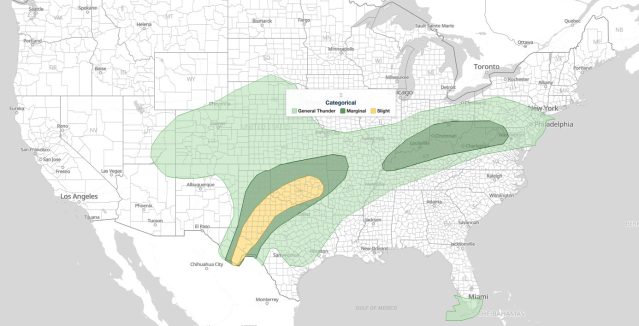
A thunderstorm is a local storm produced by a cumulonimbus cloud that contains lightning and thunder. Thunderstorms require three ingredients: moisture, a lifting mechanism (fronts, terrain, surface heating), and instability (warm air near the surface, colder air aloft). There are four main types:
- Single-cell: Short-lived, relatively weak; typically lasts 20–30 minutes
- Multi-cell cluster: Group of cells at different stages; can last several hours
- Squall line: A long, organized line of thunderstorms, often ahead of a cold front
- Supercell: The most severe type; features a persistent, rotating updraft (mesocyclone) capable of producing large hail, damaging winds, and tornadoes
See also: Life cycle of thunderstorms
Severe Thunderstorm Warning
A Severe Thunderstorm Warning is issued by the National Weather Service when a thunderstorm is producing or is expected to produce hail 1 inch (quarter size) or larger and/or wind gusts of 58 mph or greater. The NWS uses a three-tier severity tagging system:
- Base Severe: Hail ≥ 1 inch and/or winds ≥ 58 mph
- Considerable: Hail ≥ 1.75 inches (golf ball) and/or winds ≥ 70 mph; significant damage likely
- Destructive: Hail ≥ 2.75 inches (baseball) and/or winds ≥ 80 mph; triggers Wireless Emergency Alerts to all phones in the warned area
Seek sturdy shelter during a Severe Thunderstorm Warning. A vehicle is not safe shelter from large hail or damaging winds.
See also: Criteria for a Severe Thunderstorm Warning
Tornado
A tornado is a violently rotating column of air extending from a thunderstorm to the ground. Tornadoes are rated on the Enhanced Fujita (EF) Scale based on damage indicators:
- EF0: 65–85 mph, Light damage; broken branches, minor roof damage
- EF1: 86–110 mph, Moderate damage; roof surfaces peeled off, mobile homes overturned
- EF2: 111–135 mph, Considerable damage; roofs torn off well-constructed homes, large trees snapped
- EF3: 136–165 mph, Severe damage; entire stories of well-constructed homes destroyed
- EF4: 166–200 mph, Devastating damage; well-constructed homes leveled
- EF5: Over 200 mph, Incredible damage; strong frame homes swept away, reinforced structures critically damaged
Tornadoes can occur in every U.S. state and at any time of year, though they are most common in spring and early summer across the central United States. The average tornado is on the ground for less than 10 minutes and travels less than 6 miles, but violent tornadoes have tracked hundreds of miles.
See also: How tornadoes form | Tornado facts | Tornado safety
Tornado Alley
Tornado Alley is an informal term for the region of the central United States that experiences a disproportionately high frequency of tornadoes. It generally encompasses portions of Texas, Oklahoma, Kansas, Nebraska, and South Dakota, where warm moist air from the Gulf of Mexico collides with dry air from the west and cold air from Canada. In recent decades, research has shown that a “Dixie Alley” in the Southeast, including Mississippi, Alabama, Tennessee, and Georgia, experiences similar or greater tornado frequency, particularly at night and in the fall.
Tornado Emergency
A Tornado Emergency is the highest-level tornado alert issued by the National Weather Service. It is reserved for rare, life-threatening situations when a confirmed, violent tornado (typically EF3 or stronger) is moving toward a densely populated area. The statement uses urgent, direct language such as “This is a life-threatening situation” and “Take cover immediately.” A Tornado Emergency triggers a Wireless Emergency Alert (WEA) on all cell phones in the impacted area. If you receive a Tornado Emergency alert, get to your safe shelter immediately, do not delay for any reason.
Tornado Warning
A Tornado Warning is issued by the National Weather Service when a tornado has been indicated by weather radar or reported by a trained spotter. This is an imminent threat to life and property. When a Tornado Warning is issued for your area:
- Move immediately to the lowest floor of a sturdy building
- Get to an interior room away from windows, a bathroom, closet, or hallway
- If in a mobile home or vehicle, abandon it and seek sturdy shelter or lie flat in a low-lying ditch away from trees and cars
- Do not try to outrun a tornado in a vehicle in urban or congested areas
Tornado Warnings are typically valid for 30–60 minutes but can be extended. The warning will specify the polygon of affected counties and the storm’s movement direction and speed.
See also: Criteria for a Tornado Warning | Tornado Myths
Tornado Watch
A Tornado Watch is issued by NOAA’s Storm Prediction Center (SPC) when atmospheric conditions are favorable for tornado development over a large geographic area, typically covering several counties or multiple states, for a period of several hours. A Watch does not mean a tornado is occurring, it means conditions are ripe and you should be prepared to act. During a Tornado Watch:
- Know where your safe shelter is before you need it
- Monitor weather updates via a NOAA Weather Radio, weather app, or local media
- Be ready to move to shelter quickly if a Tornado Warning is issued
- Avoid unnecessary travel; keep your phone charged
A Particularly Dangerous Situation (PDS) Tornado Watch is a rarely-issued, higher-urgency watch reserved for outbreaks with the potential for multiple violent (EF3+) tornadoes.
Tornado Watch vs. Tornado Warning, Key Differences
| Tornado Watch | Tornado Warning | |
|---|---|---|
| What it means | Conditions are favorable for tornado development | A tornado is confirmed by radar or spotter, imminent threat |
| Issued by | NOAA Storm Prediction Center (national) | Local NWS Forecast Office |
| Area covered | Large multi-county or multi-state region | Small, specific polygon, the directly threatened area |
| Duration | Several hours (typically 4–8 hours) | 30–60 minutes (extended if needed) |
| Urgency | Elevated, Be ready to act | Critical, Take shelter immediately |
| What to do | Know your shelter; monitor weather; keep phone charged; be ready to move | Move immediately to the lowest floor, interior room, away from windows |
Tornado Warnings Happen With Little Notice, Be Ready
iAlert monitors NWS tornado and severe thunderstorm warnings around the clock and sends you an immediate alert the moment your area is threatened. Setup takes under 2 minutes for any U.S. location.
Get Tornado & Severe Weather Alerts →Trade Winds
The trade winds are persistent, easterly winds that blow toward the equator from the subtropical high-pressure zones near 30° latitude. In the Northern Hemisphere they blow from the northeast; in the Southern Hemisphere from the southeast. Trade winds play a critical role in the development of Atlantic hurricanes, tropical waves move off the west coast of Africa and are carried westward by the trades. El Niño and La Niña events alter trade wind strength, which in turn dramatically affects hurricane activity and drought or flood patterns across North America.
Tropical Cyclone
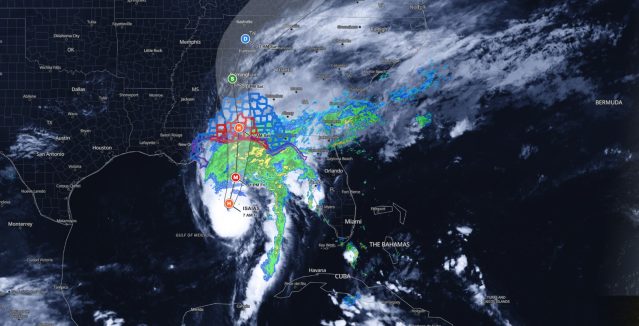
Tropical cyclone is the general term for a warm-core, non-frontal low-pressure system that develops over tropical or subtropical ocean waters. All hurricanes, typhoons, and tropical storms are types of tropical cyclones. Classification is based on maximum sustained wind speed:
| Classification | Sustained Winds | Notes |
|---|---|---|
| Tropical Disturbance | No defined threshold | Cluster of storms; little to no rotation |
| Tropical Depression | Up to 38 mph | Organized circulation; monitored by NHC |
| Tropical Storm | 39–73 mph | Receives a name; Tropical Storm Watch/Warning issued |
| Hurricane (Cat. 1–2) | 74–110 mph | Hurricane Watch/Warning issued |
| Major Hurricane (Cat. 3–5) | 111+ mph | Catastrophic potential; evacuation orders common |
Tropical Depression
A tropical depression is an organized area of low pressure over tropical waters with a defined circulation and maximum sustained winds of 38 mph (33 knots) or less. It is the first official classification in the tropical cyclone development scale. Tropical depressions are monitored closely by the National Hurricane Center, if conditions remain favorable, a depression can intensify into a tropical storm within 24 hours. Even depressions that fail to strengthen can bring significant rainfall and flooding to coastal areas.
Tropical Disturbance
A tropical disturbance is a discrete area of organized thunderstorm activity that maintains its identity for 24 hours or more in the tropics. It has no closed circulation and is the earliest stage in tropical cyclone development. Meteorologists track disturbances, particularly those moving off the west coast of Africa during hurricane season, assigning 2-day and 5-day development probabilities. Many disturbances dissipate, but some intensify into tropical depressions, storms, and ultimately hurricanes.
Tropical Storm
A tropical storm is a tropical cyclone with maximum sustained winds between 39 and 73 mph (34–63 knots). When a tropical depression reaches 39 mph sustained winds, it is officially named from the seasonal list maintained by the World Meteorological Organization. Tropical storms can produce significant storm surge, rainfall totals of 5–10 inches or more, and isolated tornadoes, all of which can be life-threatening even without hurricane-force winds. Flooding from tropical storms is the leading cause of tropical cyclone fatalities in the United States.
Tropical Storm Warning
A Tropical Storm Warning is issued when tropical storm conditions, sustained winds of 39–73 mph, are expected within a specified coastal area within 36 hours. When a Tropical Storm Warning is issued, all preparations for the storm should be completed. Expect dangerous surf, coastal flooding, heavy rainfall, and potential tornado activity well inland. Residents in low-lying areas should consider evacuation, flooding from a tropical storm can be as deadly as a hurricane.
Tropical Storm Watch
A Tropical Storm Watch is issued when tropical storm conditions are possible within a specified coastal area within 48 hours. A Watch provides the window to finalize preparations: stock emergency supplies, fuel vehicles, review evacuation routes, and secure outdoor items. Tropical Storm Watches often precede Hurricane Watches as a storm approaches, conditions can deteriorate faster than forecast.
Tropical Wave (Easterly Wave)
A tropical wave, also called an easterly wave or African easterly wave, is a westward-moving trough of low pressure embedded in the trade winds. These waves develop over western Africa and travel across the tropical Atlantic Ocean. The majority of Atlantic hurricanes originate from tropical waves. The National Hurricane Center tracks each wave that moves off the African coast during hurricane season and assigns development probabilities based on atmospheric conditions along its path.
Tropopause
The tropopause is the boundary layer between the troposphere (the lowest atmospheric layer where weather occurs) and the stratosphere above it. It acts as a “lid” on weather systems, the tropopause marks the altitude at which temperature stops decreasing with height and begins to increase. In the tropics the tropopause sits at approximately 55,000 feet; at the poles it is closer to 25,000 feet. When a severe thunderstorm’s updraft is powerful enough to punch through the tropopause into the stratosphere, it creates an “overshooting top” visible on satellite imagery, a strong indicator of extreme storm intensity.
Troposphere
The troposphere is the lowest layer of Earth’s atmosphere, extending from the surface to approximately 7–12 miles in altitude depending on latitude and season. It contains roughly 75% of the atmosphere’s total mass and virtually all of its water vapor. All weather as we experience it, wind, clouds, precipitation, storms, occurs within the troposphere. Temperature generally decreases with altitude in the troposphere at approximately 3.5°F per 1,000 feet, which drives the instability needed for thunderstorm development.
Trough
A trough is an elongated area of relatively low atmospheric pressure that extends from the center of a low-pressure system. Troughs are regions of atmospheric divergence and upward motion that promote cloud development, precipitation, and storm activity. An upper-level trough (found at jet stream levels) is particularly important for severe weather, when a strong upper-level trough interacts with surface moisture and instability, it can trigger significant thunderstorm and tornado outbreaks. Troughs are the opposite of ridges, which are elongated areas of high pressure associated with fair weather.
Tsunami
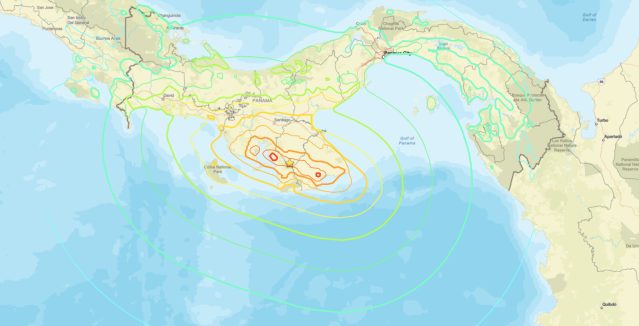
A tsunami is a series of large ocean waves generated by a sudden, large-scale displacement of ocean water, most commonly caused by a submarine earthquake, but also by volcanic eruptions, submarine landslides, or large meteor impacts. Tsunamis can travel across entire ocean basins at speeds up to 500 mph with minimal wave height in deep water. As they approach shallow coastal areas, they slow, and wave height increases dramatically, sometimes to 100 feet or more. A telltale warning sign is the sudden and unusual withdrawal of water from the shoreline: if the sea rapidly recedes, move immediately to high ground and do not return until officials declare it safe.
Tsunami Advisory
A Tsunami Advisory is issued when a tsunami with the potential to produce strong currents or waves dangerous to those in or very near the water is imminent, expected, or occurring. It is a lower-level alert than a Tsunami Warning. Coastal residents in the advisory area should stay out of the water, stay off beaches, and away from harbors and marinas. Strong currents associated with a Tsunami Advisory can overturn vessels and sweep people off their feet.
Tsunami Warning
A Tsunami Warning is the highest-level tsunami alert, issued when a tsunami with the potential to generate widespread inundation is imminent, expected, or occurring. Evacuation of coastal areas is strongly recommended. The National Tsunami Warning Center (NTWC) issues Tsunami Warnings within minutes of a qualifying seismic event. Do not wait for official confirmation of wave arrival before evacuating, vertical evacuation (upper floors of a reinforced building) is only an option if higher ground cannot be reached in time.
Tsunami Watch
A Tsunami Watch is issued to alert communities that a tsunami may be generated by a distant seismic event, typically one that occurred more than 3 hours away by tsunami travel time. It gives coastal residents and emergency managers time to prepare for a possible evacuation order. A Watch may be upgraded to a Warning or canceled as more data becomes available. During a Tsunami Watch, move away from the coast to higher ground or inland as a precaution and monitor official emergency alerts.
Turbulence
Turbulence is irregular, chaotic air motion caused by disruptions in the smooth flow of air. Common causes include:
- Convective turbulence: Caused by thermal updrafts and thunderstorms; most common in summer afternoons
- Clear Air Turbulence (CAT): Occurs at high altitudes near the jet stream with no visual warning; dangerous for aircraft
- Mountain wave turbulence: Generated when wind flows over terrain features; can extend hundreds of miles downwind
- Wind shear turbulence: Caused by rapid changes in wind speed or direction over a short distance
At the surface, turbulent wind gusts during severe thunderstorms can exceed 80 mph, making them a direct severe weather hazard.
Typhoon
A typhoon is a tropical cyclone with sustained winds of 74 mph or greater that forms in the western North Pacific Ocean (generally west of the International Date Line). It is meteorologically identical to a hurricane, the same storm type in a different ocean basin. The western Pacific is the most active tropical cyclone basin in the world, producing an average of 25–30 named storms per year. Super Typhoons, the equivalent of major hurricanes (Category 3+), are common in this basin. U.S. territories Guam and the Northern Mariana Islands are regularly threatened by typhoons.
Frequently Asked Questions, “T” Weather Terms
What is the difference between a Tornado Watch and a Tornado Warning?
A Tornado Watch means atmospheric conditions are favorable for tornado development over a large area, be prepared to act but no tornado is occurring yet. A Tornado Warning means a tornado has been confirmed by weather radar or a trained spotter and is an imminent threat, take shelter immediately in the lowest floor of a sturdy building, away from windows. A Watch is issued by the national Storm Prediction Center; a Warning is issued by your local NWS office for a much smaller, specific area.
What should I do during a Tornado Warning?
Move immediately to the lowest floor of a sturdy building and get to an interior room away from windows, a bathroom, closet, or interior hallway. If you are in a mobile home, abandon it immediately, mobile homes offer no protection from tornadoes even if tied down. If caught outdoors with no shelter available, lie flat in a low-lying ditch or culvert, away from trees and vehicles, and cover your head. Do not try to outrun a tornado by car in urban or suburban areas.
What is a Tornado Emergency and how is it different from a regular Tornado Warning?
A Tornado Emergency is the highest-level tornado alert the NWS issues. It is reserved for rare situations when a confirmed violent tornado (typically EF3 or stronger) is bearing down on a densely populated area. Unlike a standard Tornado Warning, a Tornado Emergency uses extreme language (“catastrophic”, “unsurvivable”), triggers a Wireless Emergency Alert on all phones in the area, and is broadcast with the most urgent tone possible. Take cover immediately, there is no time to gather belongings or secure property.
What is a PDS Tornado Watch?
A PDS (Particularly Dangerous Situation) Tornado Watch is a higher-urgency version of the standard Tornado Watch, issued by NOAA’s Storm Prediction Center on rare occasions when an outbreak has the potential for multiple violent (EF3 or stronger) long-track tornadoes. PDS Watches are issued only a handful of times per year. If a PDS Watch is issued for your area, treat it with extreme seriousness, review your shelter plan, charge your phone, and stay close to a reliable weather alert source.
What is the difference between a Tropical Storm and a Hurricane?
A Tropical Storm has maximum sustained winds between 39 and 73 mph. When sustained winds reach 74 mph, the storm is officially upgraded to a Hurricane. Both are types of tropical cyclones, but hurricanes are significantly more powerful and are rated Category 1 through Category 5 on the Saffir-Simpson Wind Scale. Even tropical storms should be taken seriously, their rainfall and storm surge can cause life-threatening flooding well before winds reach hurricane strength.
How is tornado strength measured?
Tornado strength is measured after the event using the Enhanced Fujita (EF) Scale, which rates tornadoes from EF0 (65–85 mph, light damage) to EF5 (over 200 mph, catastrophic damage). Ratings are assigned by NWS meteorologists who conduct damage surveys, examining specific damage indicators, structural damage to buildings, uprooted trees, vehicles displaced, rather than actual wind measurements, since instruments rarely survive a direct tornado hit.
Never Miss a Tornado Warning or Severe Weather Alert
iAlert monitors National Weather Service watches, warnings, and advisories around the clock and sends you an immediate notification the moment your area is threatened. Works for any U.S. location, home, office, school, or a city where your family lives.
View All Alert Services → Severe Weather Alerts Specifically →Related Articles
- Get real-time Severe Weather Email & Text Alerts
- How tornadoes form
- Tornado facts
- Tornado Safety
- Tornado Myths
- Criteria for a Tornado Warning
- Criteria for a Severe Thunderstorm Warning
- Criteria for a Tropical Storm Warning
- What is a Tropical Cyclone?
- Know the Hurricane Hazard Terms
- What is a Supercell thunderstorm?
- Life cycle of a thunderstorm
- Thunderstorm basics: structure, types, and forecasting
- Understanding the NWS Severe Weather Outlook
- WxData.com, Weather Data API for apps and systems